How banks ensure innovative strength through systematic venture clienting

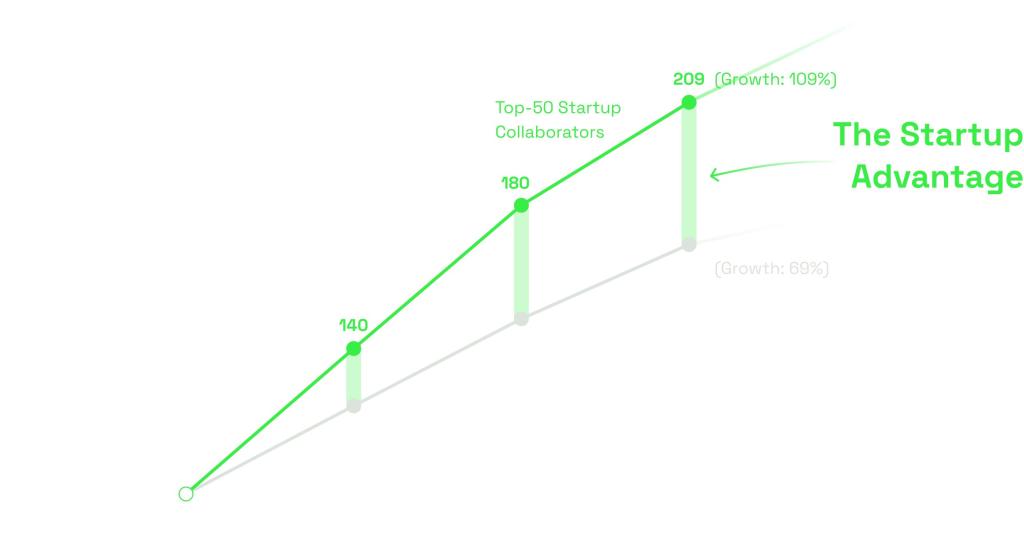
The financial sector is facing a dilemma: pressure to innovate is increasing while budgets are shrinking. 75% of companies are not planning to increase their innovation expenditure in 2025. At the same time, technological change is accelerating, driven by AI, regulation and changing customer expectations.
Leading financial institutions have recognized that external innovation is not a substitute for internal development, but a strategic lever that ensures innovative strength even in budget-limited times.
28,000 partnerships: Venture clienting has long been the standard
A recent analysis by GlassDollar examines more than 250,000 corporate start-up relationships worldwide.
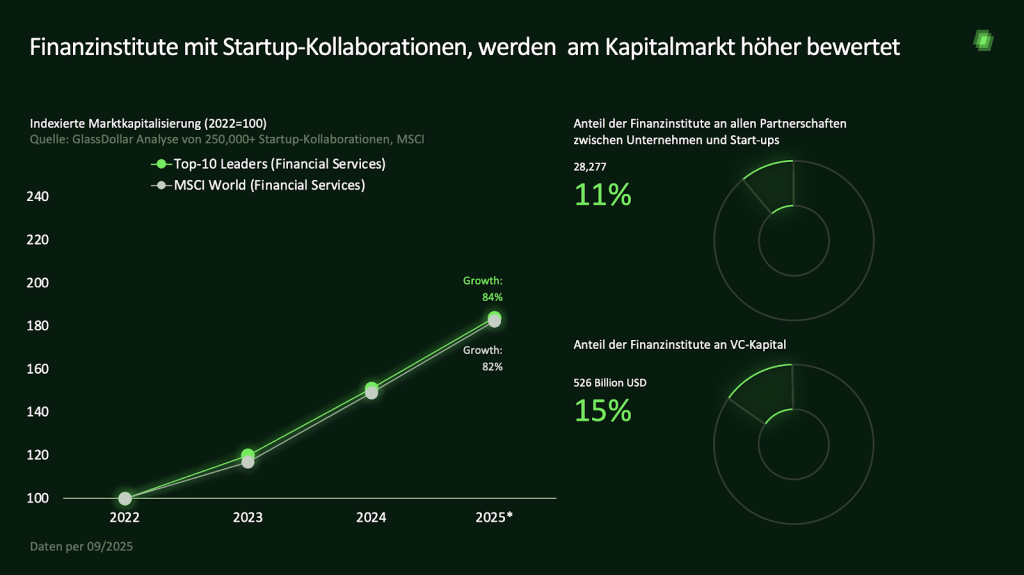
The result: with over 28,000 documented partnerships, Financial Services is one of the most active sectors in venture clienting.
The figures speak for themselves:
- 11% of all global corporate startup partnerships are in Financial Services
- Leading institutions have 500+ active collaborations running in parallel
- 15% of the total venture capital volume raised through corporate partnerships comes from the financial sector
Notably, financial institutions account for 11% of partnerships but raise 15% of VC capital. This means that banks work specifically with highly capitalized, mature startups/scaleups, which in turn is a sign of professional, risk-optimized innovation management.
Why venture clienting secures innovative strength
The strategic value of venture clienting lies in three fundamental advantages:
1. access to externally financed innovation capital
While internal innovation budgets are stagnating, venture capital funds continue to invest billions in fintechs and technology start-ups. The figures are clear: external innovation capital (VC investments in start-ups) has already overtaken internal R&D by a factor of 1.7x.
Through systematic partnerships, banks are tapping into this external capital without bearing the full development risk themselves. A startup that has received 50 million dollars in VC funding already brings with it validated technology, experienced teams and market access and therefore resources that would take years and cost significantly more internally.
2. speed instead of lengthy in-house development
Time-to-market is crucial. Start-ups have already developed functioning solutions and tested them on the market. Instead of investing three to five years in in-house development, banks can integrate proven technologies in just a few months.
The result is a faster response to market changes, shorter innovation cycles and direct access to cutting-edge technology.
3. strategic focus on core competencies
Not every technological challenge needs to be solved internally. By selectively outsourcing "undifferentiated heavy lifting" to specialized startup partners, banks can focus on their true differentiators: Customer relationships, risk management and regulatory expertise.
Three strategic fields: Where banks systematically use startups
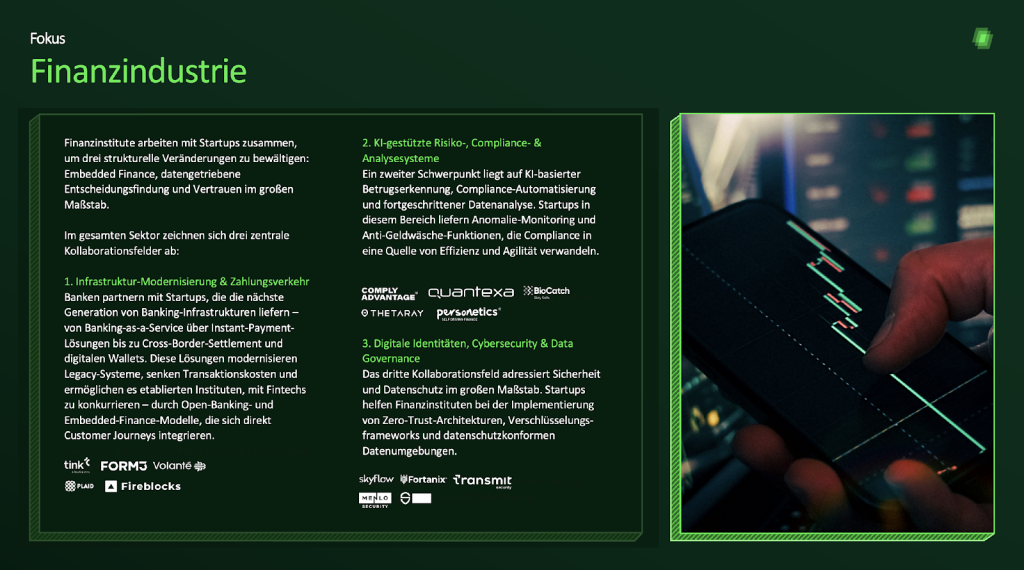
The 28,000 partnerships focus on three clearly defined fields of innovation:
Infrastructure Modernization & Payments
Legacy systems are one of the biggest obstacles to innovation in the financial sector. Startups deliver modern banking infrastructures: from banking-as-a-service to instant payment solutions and cross-border settlement.
This can reduce transaction costs, accelerate processes and enable new business models such as embedded finance - without years of system migrations.
AI-supported risk & compliance systems
Regulatory requirements are constantly growing, especially in the financial sector. At the same time, the volume of data is increasing exponentially. AI-based start-up solutions automate compliance processes, detect anomalies in real time and improve anti-money laundering mechanisms.
The added value: a growing cost factor becomes an efficiency gain. Compliance becomes faster, more precise and more scalable.
Digital identities & cybersecurity
As digitalization increases, so do security requirements. Start-ups are developing zero-trust architectures, encrypted data environments and data protection-compliant analysis systems.
This leads to greater security combined with a better user experience and therefore a decisive competitive advantage.
From pilots to portfolio management: a systematic approach makes all the difference
However, not every start-up partnership automatically leads to measurable success. The data shows that a systematic approach is the decisive success factor. Leading financial institutions have professionalized venture clienting in recent years, transforming it from an experimental pilot project into a strategic core capability.
The success factors at a glance:
Business unit integration instead of innovation theater:
The most successful partnerships are formed where business units assume direct responsibility. Isolated innovation labs with no connection to the core business produce pilots, but no impact. Leading banks therefore establish dedicated venture clienting teams that coordinate scouting, evaluation and integration, with clear budgets and direct responsibility for success.
Measurable results instead of key activity figures:
Instead of "number of pilots", P&L-relevant metrics count: cost reductions, revenue increases, efficiency gains. Institutes define clear business cases even before the first contact with a startup and increasingly use AI-supported platforms that identify the most suitable startups based on technology fit, implementation maturity and business case potential.
Accelerated processes through standardization:
The biggest hurdle for startup partnerships is often internal processes. Successful programs rely on pre-negotiated frameworks, template-based contracts and accelerated due diligence processes. The time from initial contact to contract signing is reduced from months to weeks thanks to the early involvement of procurement, legal and compliance.
Portfolio management instead of individual projects:
Leading financial institutions do not run individual pilot projects, but manage portfolios of 50+ active startup relationships in parallel. With clear selection criteria, stage gates and key performance indicators. Venture clienting is no longer viewed in isolation, but as an integral part of the overall strategy, interlinked with corporate venture capital, M&A and internal R&D.
Conclusion: External innovation as a strategic competitive advantage in the financial sector
The figures clearly show that venture clienting is not a trend, but an established innovation strategy that enables financial institutions to secure innovative strength even in budget-limited times.
With over 28,000 partnerships and systematic access to billions in externally financed innovation capital, leading banks have found a way to combine speed and impact with risk management.
The key to success lies in professional implementation: clear processes, measurable goals and the integration of start-up solutions directly into the business areas. Those who see venture clienting as a strategic instrument and not as an experimental add-on create sustainable competitive advantages.
The question is no longer whether banks should work with start-ups, but how systematically they do it.
---
About the data basis: The analysis is based on GlassDollar's proprietary database with over 250,000 documented corporate-startup relationships worldwide (as of September 2025).
More about this
Venture Clienting



Newsletter
Startups, stories and stats from the German startup ecosystem straight to your inbox. Subscribe with 2 clicks. Noice.
LinkedIn ConnectFYI: English edition available
Hello my friend, have you been stranded on the German edition of Startbase? At least your browser tells us, that you do not speak German - so maybe you would like to switch to the English edition instead?
FYI: Deutsche Edition verfügbar
Hallo mein Freund, du befindest dich auf der Englischen Edition der Startbase und laut deinem Browser sprichst du eigentlich auch Deutsch. Magst du die Sprache wechseln?