Study by the European Patent Office: proportion of women holding patents in Germany stagnates at around 10 percent

A new study by the Observatory for Patents and Technology of the European Patent Office (EPO) shows that despite increasing numbers of women in STEM professions, their share of patent applications in Germany remains at a low level. The proportion of women remains at around ten percent, which is well below the European average.
The study was published in the run-up to International Women's Day and provides Europe-wide comparable data on women in innovation, deep-tech entrepreneurship and patent professions.
Slow progress at European level
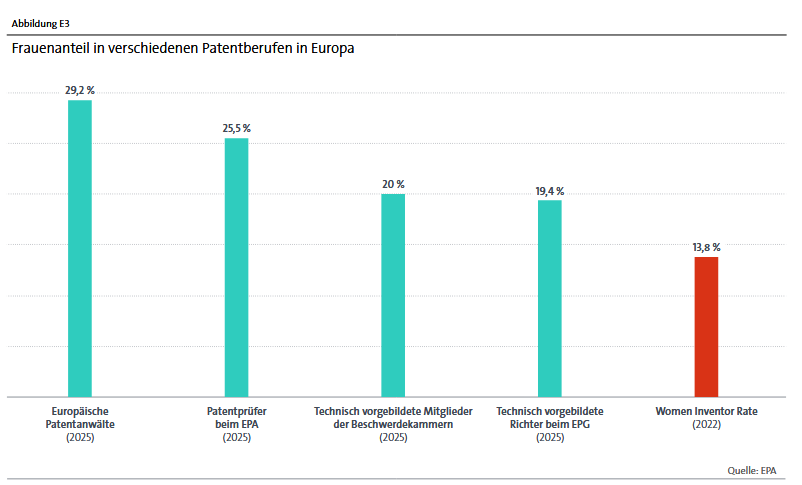
Across Europe, the proportion of female inventors in patent applications rose only slightly: from 13% in 2019 to 13.8% in 2022. Although women are often part of mixed teams of inventors, they are significantly less likely to be individual inventors.
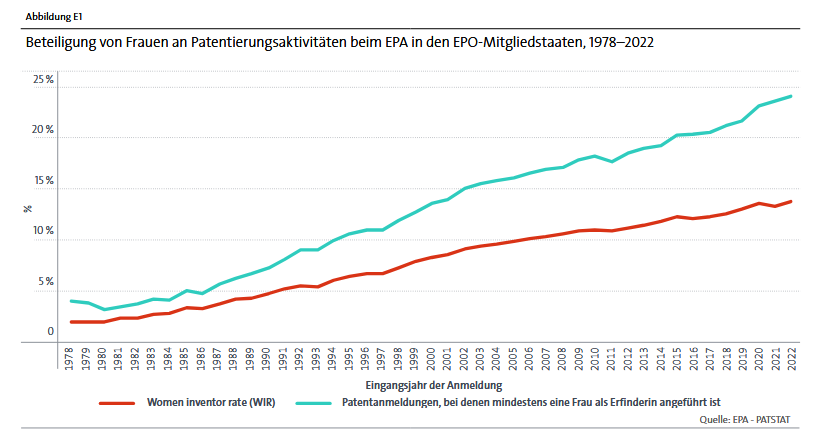
The picture for Germany is particularly subdued: the so-called Women Inventor Rate (WIR) only rose from 9.7% in the period 2013-2017 to 10.3% in the years 2018-2022. This means that Germany remains one of the countries with the lowest participation rates in the European patent system.
One of the main reasons for this is the structure of German patent applications: The proportion of company-driven applications is high, while universities and public research institutions - which tend to have higher proportions of women - contribute comparatively less. In addition, Germany is highly specialized in fields of technology in which traditionally few women patent.
Regional differences: Düsseldorf and Rostock stand out
Among the German regions, Düsseldorf has the highest rate of female inventors. At 19.1% in the period 2018-2022, the city is above the national average and ranks sixth among Europe's leading innovation clusters. This strong position is primarily attributed to regional specialization in the chemical sector.
Rostock developed particularly dynamically: the proportion of female inventors doubled from 11% (2013-2017) to 22% (2018-2022). This makes the Hanseatic city one of the fastest growing innovation regions in Europe and puts it in ninth place in this category.
Large gap in tech entrepreneurship
The gender gap is particularly evident in start-ups with patent applications. Across Europe, only 13.5% of these companies have at least one female founder.
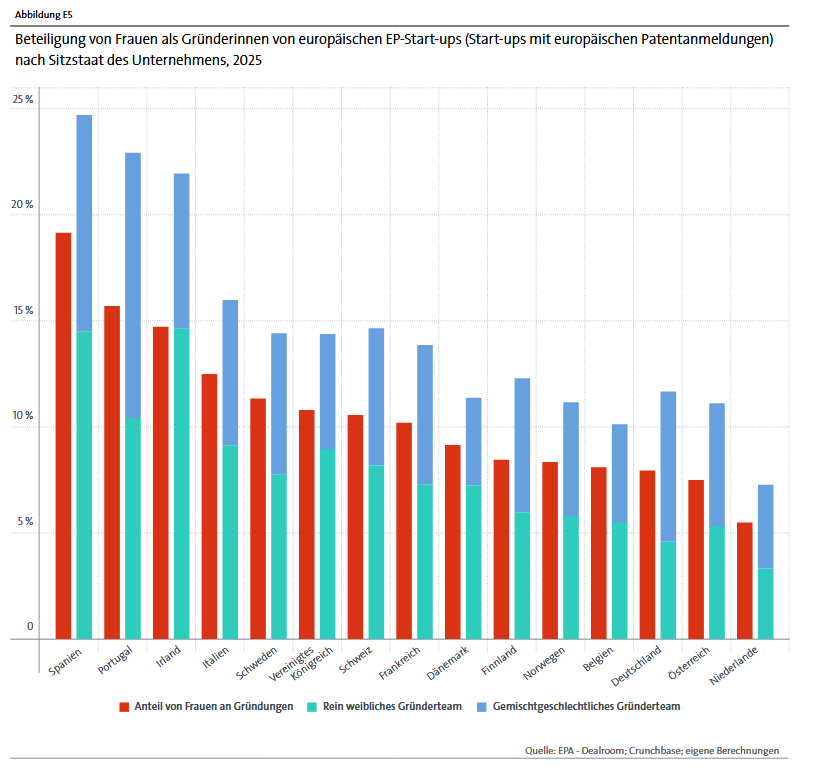
Germany is one of the laggards here: Women make up only 7.6 percent of all founders in patenting startups. Looking at teams with at least one female founder, the proportion is 12.4%. By comparison, the proportion of female founders in non-patented start-ups in the same sectors in Germany is 18% on average - more than twice as high.
It is also striking that the proportion of women is higher in younger start-ups than in older companies. However, the proportion decreases significantly as the financing maturity increases, which indicates structural hurdles in later growth phases.
Strong differences by technology field
The participation of women varies considerably depending on the sector. The proportion is particularly high in life sciences sectors such as pharmaceuticals (34.9%), biotechnology (34.2%) and food chemistry (32.3%).
In patent-intensive engineering disciplines, on the other hand, women are strongly underrepresented. In areas such as machine tools (5.7 percent), basic communication processes (5.5 percent) and mechanical components (4.9 percent), the figures are particularly low.
Universities and public research institutions have the highest proportion of female inventors at 24.4 percent. Small and medium-sized enterprises and individual applicants are at the lower end of the scale.
"Leaky pipeline" despite comparable innovation potential
The study confirms a well-known pattern: although women are strongly represented at doctoral level, their share decreases with each career stage, especially during the transition to commercialization and entrepreneurship. This phenomenon is often described as a "leaky pipeline".
The data shows that the innovation potential of women's research work is comparable to that of men. The lower patent participation cannot therefore be explained by differences in quality, but rather points to structural, institutional and economic barriers.
Women in patent professions: Catching up with room for improvement
The proportion of women in patent professions is developing positively: Across Europe, they now make up 29.2 percent of patent attorneys, and the trend is rising.
In Germany, the proportion was 20.7% in 2025. Although this represents an increase of 4.6 percentage points since 2015, Germany remains below the European average and has the second-lowest proportion among the EPO member states, despite having the highest absolute number of registered patent attorneys.

Newsletter
Startups, stories and stats from the German startup ecosystem straight to your inbox. Subscribe with 2 clicks. Noice.
LinkedIn ConnectFYI: English edition available
Hello my friend, have you been stranded on the German edition of Startbase? At least your browser tells us, that you do not speak German - so maybe you would like to switch to the English edition instead?
FYI: Deutsche Edition verfügbar
Hallo mein Freund, du befindest dich auf der Englischen Edition der Startbase und laut deinem Browser sprichst du eigentlich auch Deutsch. Magst du die Sprache wechseln?