The smart alternative for start-ups in times of scarce venture capital

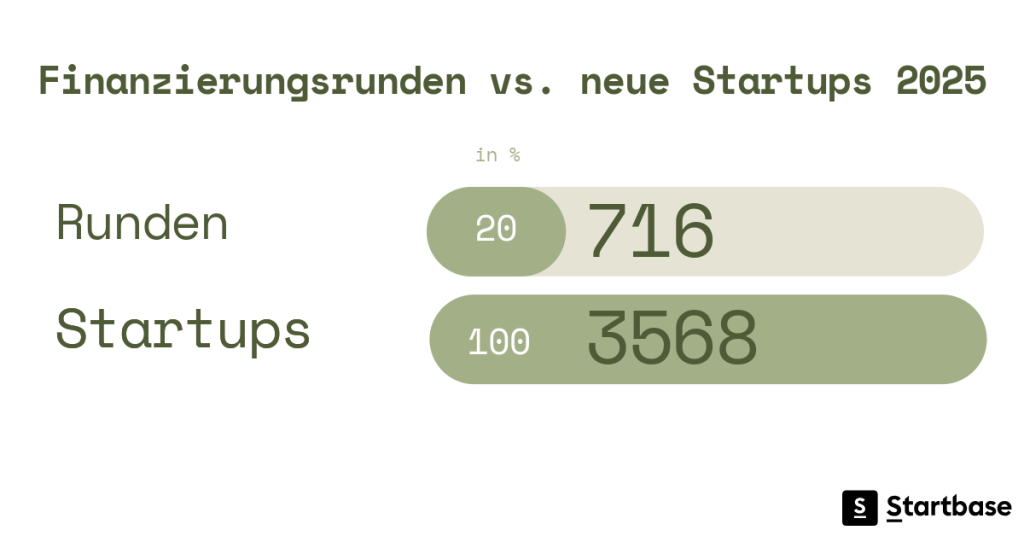
The year 2025 brought mixed news for the German startup scene: According to the EY Startup Barometer, only 716 deals were concluded. This corresponds to a drop of 5% compared to the previous year. At the same time, start-up activity boomed: the Startup Association counted 3,568 new start-ups. In purely mathematical terms, this means that only around 20% of start-ups gain direct access to venture capital via traditional financing rounds.
The individual figures are certainly debatable, as different values for the number of startups and financing rounds can be determined depending on the available data basis. Irrespective of these deviations, however, a clear trend cannot be denied: There is a clear mismatch between the pure number of newly founded startups and the number of financing rounds that actually take place. If the existing startup landscape is also included in the analysis, this gap widens further and underlines the structural discrepancy between supply and available financing.
Venture clienting as a financing option for start-ups
For founders who want to scale their company, this raises a key question: How can I successfully develop my startup without being dependent on financing that only reaches a few people anyway? The answer is venture clienting.
With venture clienting, a startup becomes a direct customer of an established company. Instead of fighting for capital in costly and uncertain financing rounds, the startup sells its solution directly to the company that has a specific problem. This not only provides a reliable source of income, but also involves the founders directly in the implementation and optimization of their solution.
Why is this so attractive for founders?
- Financing security without outside capital: Having a paying major customer significantly reduces the financial risk.
- Fast market feedback: By working directly with the customer, products are not developed in a laboratory, but tested and improved on real problems.
- Network and scaling effects: Satisfied venture clients can serve as reference customers and open up further market opportunities.
- Strategic partnerships: Start-ups benefit not only from sales, but also from access to know-how, infrastructure and potential follow-up orders.
Venture clienting as a pragmatic alternative
Especially in an environment in which traditional venture capital is scarce and the number of start-ups is constantly growing, venture clienting offers a pragmatic, low-risk and more market-oriented alternative for growing as a start-up. For founders, this means less time spent negotiating financing rounds and more time developing real solutions.
Venture clienting is therefore much more than a sales model. It is a strategy that brings founders directly closer to their customers and at the same time lays the foundation for sustainable growth. Especially in times when capital is not automatically available, this approach could make the difference between survival and take-off.
More about this
Venture Clienting



Newsletter
Startups, stories and stats from the German startup ecosystem straight to your inbox. Subscribe with 2 clicks. Noice.
LinkedIn ConnectFYI: English edition available
Hello my friend, have you been stranded on the German edition of Startbase? At least your browser tells us, that you do not speak German - so maybe you would like to switch to the English edition instead?
FYI: Deutsche Edition verfügbar
Hallo mein Freund, du befindest dich auf der Englischen Edition der Startbase und laut deinem Browser sprichst du eigentlich auch Deutsch. Magst du die Sprache wechseln?