835 million euros for battery storage. Return secures innovative financing for Germany

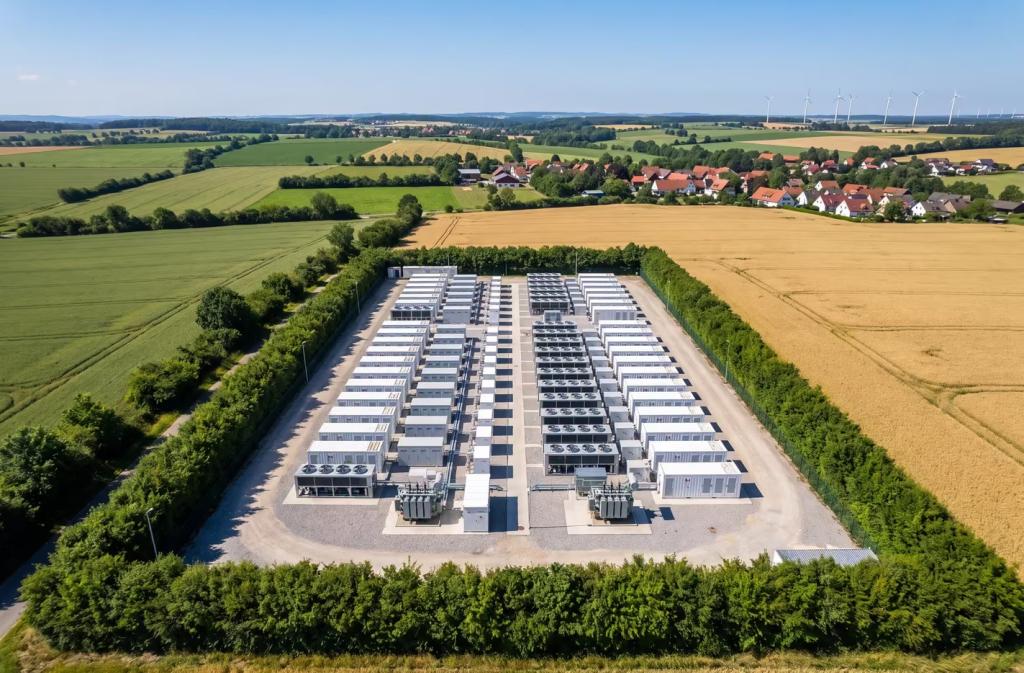
European battery storage provider Return has secured portfolio financing of 835 million euros from Deutsche Bank and Rabobank. According to the company, this is the first financing of its kind in Germany to combine physical battery storage with a virtual flexibility portfolio. Return plans to use the capital to accelerate the expansion of its storage infrastructure and install at least one gigawatt of new battery storage capacity annually starting in 2027.
The expansion of renewable energy is presenting new challenges for the German power grid. While wind and solar plants generate ever-increasing amounts of electricity, their output fluctuates depending on the weather and time of day. Battery storage is therefore becoming increasingly important for absorbing excess energy and making it available again when needed.
Unlike traditional project financing, the capital is not allocated exclusively to individual storage sites but is organized across multiple projects through a joint financing structure. This model is intended to enable Return to finance new battery storage projects more quickly and significantly expand its business in Germany.
One gigawatt of new storage capacity planned per year
The growth plans are ambitious. Starting in 2027, Return aims to install at least one gigawatt of battery storage capacity annually in Germany. Depending on market conditions, the company expects annual investments of between 750 million and 1.2 billion euros to achieve this.
At the heart of the strategy is the so-called Virtual Flexibility Portfolio (VFP). This involves combining multiple physical battery storage systems into a virtual portfolio. Energy customers can access the bundled capacities via a central interface and manage their electricity portfolios more flexibly.
The advantage is that customers are not reliant on individual storage projects. Instead, they can meet their storage capacity needs through a larger network and take advantage of additional flexibility as demand rises.
Existing partnerships already demonstrate that demand is growing. The energy company ENGIE has expanded its collaboration with Return in Germany to include 400 megawatts of contractually secured battery flexibility. Centrica Energy has also agreed to a capacity of 100 megawatts, or 400 megawatt-hours. Outside of Germany, Return collaborates with energy companies such as Vattenfall, Essent, and Eneco.
New Financing Model Aims to Accelerate Expansion
A distinctive feature of the financing is its structure. While large battery storage systems have often been financed individually in the past, Return bundles multiple facilities within a single financing framework. This allows eligible projects to access existing financing options without requiring a completely new process for each location. This is intended to simplify capital raising and accelerate expansion.
Among the first projects are battery storage projects in Herzberg, Brilon, and Quedlinburg. Together, they have a planned capacity of 117 megawatts and are set to begin construction shortly. Additional German projects can also be implemented in the future using the new financing structure.
For Return, the agreement represents an important step in expanding its business model. CFO Daniel Witvoet sees the rising demand for flexible storage capacity, in particular, as a key growth driver.
The participating banks emphasize the importance of large-scale battery storage for the energy transition. Long-term capital, they say, can help provide the necessary infrastructure more quickly. At the same time, however, the financing underscores just how capital-intensive the expansion of modern energy infrastructure has become. While many ClimateTech companies initially rely on traditional venture capital rounds, operators of large storage facilities increasingly require substantial debt and project financing.
Whether Return achieves its planned expansion pace will depend, among other things, on permits, grid connections, and economic conditions. At least the capital is already in place for this.

Newsletter
Startups, stories and stats from the German startup ecosystem straight to your inbox. Subscribe with 2 clicks. Noice.
LinkedIn ConnectFYI: English edition available
Hello my friend, have you been stranded on the German edition of Startbase? At least your browser tells us, that you do not speak German - so maybe you would like to switch to the English edition instead?
FYI: Deutsche Edition verfügbar
Hallo mein Freund, du befindest dich auf der Englischen Edition der Startbase und laut deinem Browser sprichst du eigentlich auch Deutsch. Magst du die Sprache wechseln?