Farizon Brings Electric Trucks to Europe: Is China Now Launching an Offensive in the Commercial Vehicle Market as Well?

In the passenger car market, Chinese manufacturers have already demonstrated how quickly the established balance of power in the automotive industry can shift. Now, the next battleground could be heavy-duty commercial vehicles.
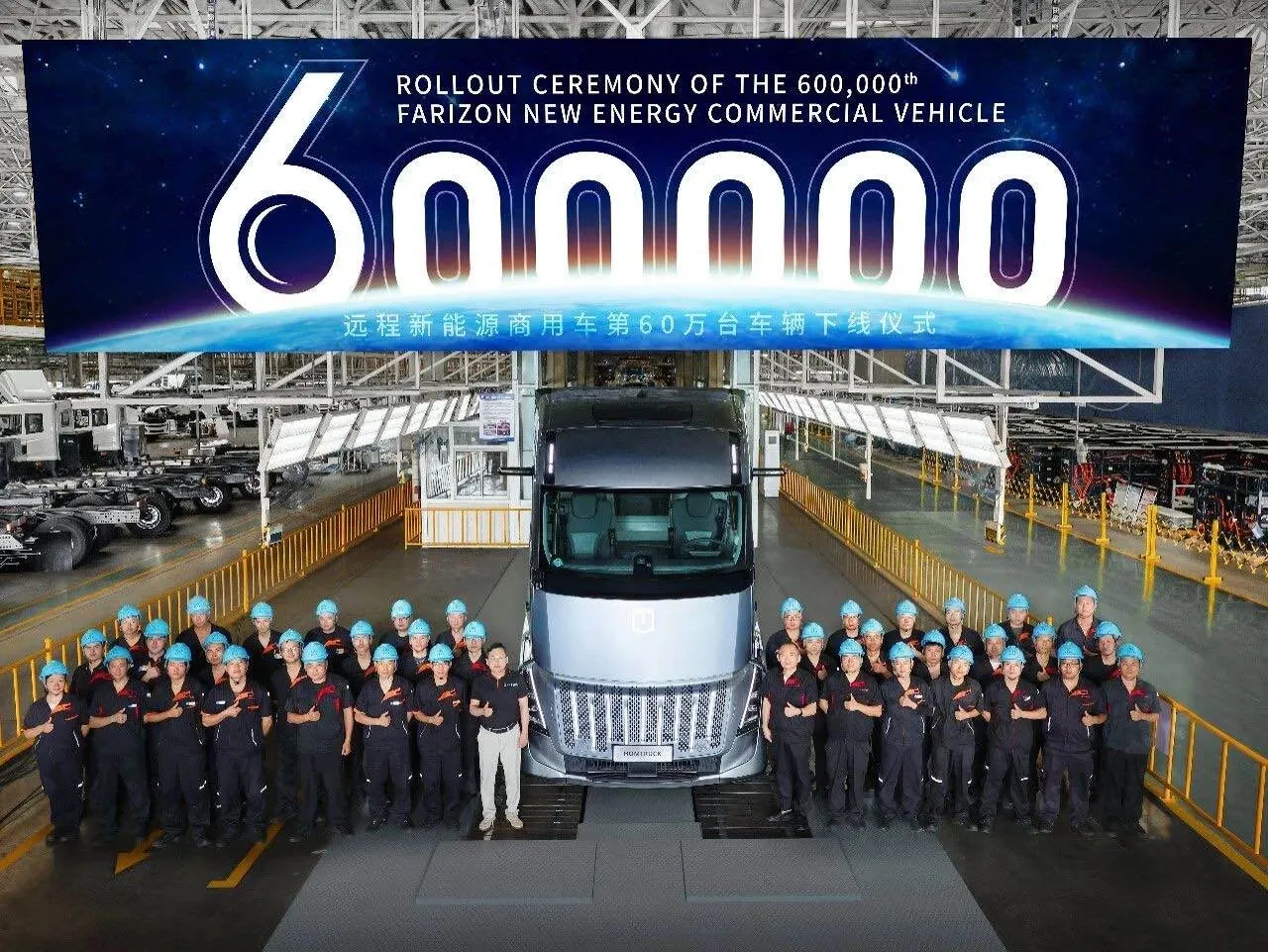
Farizon, the commercial vehicle brand of China’s Geely Group, has reached a new production milestone. The manufacturer’s 600,000th commercial vehicle rolled off the assembly line at the Ma’anshan plant. What’s particularly noteworthy is the model itself: it’s the all-electric Homtruck, a tractor-trailer designed specifically for the European market.
For European commercial vehicle manufacturers, this announcement is more than just another production figure from China. It’s a statement.
Farizon Sets Its Sights on the European Truck Market
The Homtruck features a battery with a capacity of 600 kWh, two fast-charging ports, and, according to the manufacturer, is expected to achieve a range of around 500 kilometers. At the same time, the vehicle is designed to meet the regulatory requirements of the European Union and for use in European fleets.
Farizon plans to offer the Homtruck in Europe in the future as well. This adds another serious competitor to the mix for established European commercial vehicle manufacturers. So far, Farizon has primarily been active in the light commercial vehicle segment in Germany. The company’s official launch in Germany took place as recently as April 2026 with the all-electric SV and V7E vans.
The Homtruck would mark the next step: from electric vans to heavy-duty road freight transport.
A market in which European manufacturers remain strong
While European manufacturers are already facing significant competitive pressure from Chinese brands in the passenger car sector, the commercial vehicle market has so far proven to be much more resilient.
Heavy-duty trucks, in particular, are a sector where European manufacturers have decades of experience, strong brands, extensive service networks, and close relationships with freight forwarders and fleet operators. Furthermore, conventional diesel trucks continue to generate attractive revenue and margins.
But this is precisely where a danger could lie. After all, the shift to electric mobility is not just changing the powertrain; it can also bring new competitors into a market where barriers to entry have been exceptionally high until now.
Farizon is not just a small startup that first needs to build up production capacity. The company is backed by the Geely Group. Farizon itself now reports operations in more than 60 markets and has reached the milestone of 600,000 commercial vehicles produced.
This adds a whole new dimension to the company’s announced expansion into Europe.
The first question is: Where will these trucks charge?
Before Chinese electric trucks can take over Europe’s roads, however, a very practical question must be answered: Is the infrastructure even ready for this?
An electric tractor-trailer with a 600 kWh battery places entirely different demands on the charging infrastructure than an electric passenger car. If, in the future, entire fleets of electric trucks are to be charged simultaneously at logistics centers, depots, highways, and transshipment points, this will create significant additional capacity requirements. Therefore, it’s not enough to simply install enough charging stations. Grid connections, local grid capacities, and the energy supply at these locations must also expand accordingly.
This is precisely where the pace at which the market can actually be electrified may be determined.
After all, even the most technologically advanced electric truck is of little use to a trucking company if charging times, available charging points, or grid connections make day-to-day operations difficult.
Have Europe’s manufacturers learned from the passenger car market?
An even more intriguing question, however, is this: Have European manufacturers learned their lesson from the passenger car market?
Over the years, Chinese manufacturers have caught up in terms of battery technology, software, production costs, and development speed. They now compete in Europe not only on price but increasingly also on technology, features, and product quality.
A similar trend may now be emerging in the commercial vehicle sector. European manufacturers still hold a strong position. Companies such as Daimler Truck, MAN, Volvo Trucks, Scania, and Renault Trucks have established customer relationships, service networks, and vast experience with the demands of professional fleets.
But the crucial question is not how strong this position is today. What matters is how quickly they can respond to a new competitor.
600,000 vehicles also send a message
That is precisely why the figure of 600,000 commercial vehicles produced is significant.
Farizon is demonstrating industrial-scale production and linking this production milestone, of all things, to a vehicle intended for Europe. The Homtruck is therefore not just another new electric truck. It exemplifies a development that Europe’s commercial vehicle industry should follow closely.
In the passenger car sector, Chinese manufacturers have significantly expanded their market position within just a few years. In the commercial vehicle business, established European manufacturers still have a clear home-field advantage.
The question is whether they will capitalize on it this time.
After all, should the electrification of road freight transport accelerate, a market that has so far been relatively protected and highly profitable could turn into an international technology race faster than some manufacturers would like.

Newsletter
Startups, stories and stats from the German startup ecosystem straight to your inbox. Subscribe with 2 clicks. Noice.
LinkedIn ConnectFYI: English edition available
Hello my friend, have you been stranded on the German edition of Startbase? At least your browser tells us, that you do not speak German - so maybe you would like to switch to the English edition instead?
FYI: Deutsche Edition verfügbar
Hallo mein Freund, du befindest dich auf der Englischen Edition der Startbase und laut deinem Browser sprichst du eigentlich auch Deutsch. Magst du die Sprache wechseln?