"The Million-Dollar Idea": A First Look at Ralf Dümmel's New Startup Show

With “Die Millionenidee,” Ralf Dümmel is launching a new TV series on SAT.1 that aims to turn everyday ideas into successful commercial products. The first episode shows how ideas become market-ready products, what hurdles must be overcome in the process, and why not every invention has what it takes to be a bestseller. But can the show hold its own beyond the familiar mechanics of startup competition shows? And above all, will the products actually turn into million-dollar ideas, or will they end up gathering dust on Mr. Regal’s shelf?
6,598 people from all over Germany submitted their ideas for the new SAT.1 show “Die Millionenidee – mit Ralf Dümmel.” Since November 8, 2026, the show has been following selected inventors on their journey from the initial product idea to a potential market launch. Unlike traditional startup shows, the focus is less on company valuations, equity stakes, or investment rounds. The focus is on specific consumer products that are to be developed for the mass market within a short period of time.
The concept is closely linked to the retail sector. Together with his team of experts, Dümmel reviews the submitted proposals, refines promising ideas, and has them tested for practical feasibility over several rounds. In the end, Lidl decides which products will actually go on sale by placing a corresponding order. The selected items are made available online during the broadcast and are available as promotional items in more than 3,250 Lidl stores starting the following morning.
Dümmel assumes the financial risk himself. After deducting all costs, any profit is split equally between him and the respective idea contributors. Whether this actually turns into a million-dollar business, however, depends largely on retail demand.
Four Ideas, Two Products on the Market
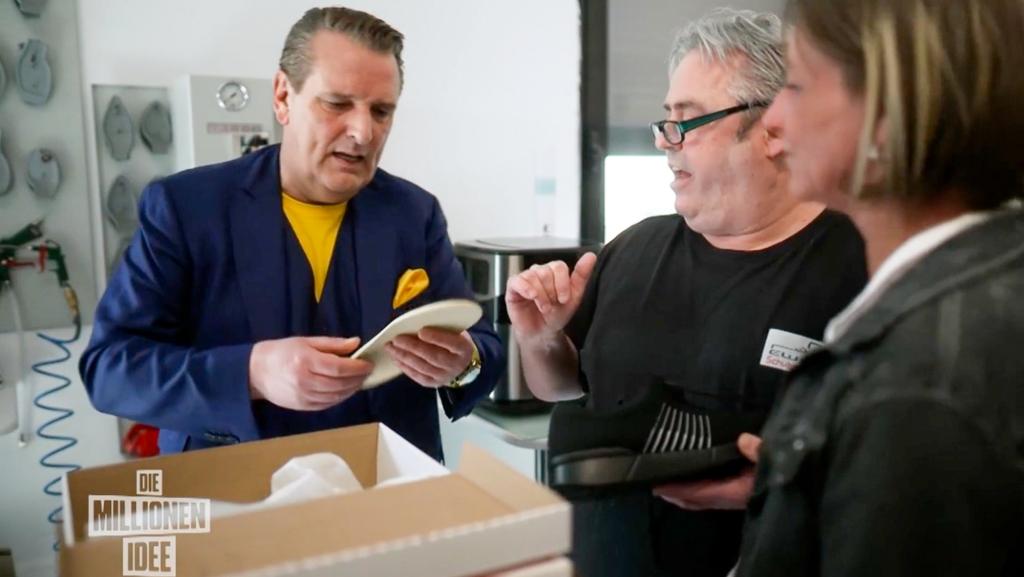
The very first episode shows just how different the participants’ starting points are. Shoemaker Matthias (60) from Dettingen unter Teck is surprised in person by Ralf Dümmel on his birthday. Together with his wife Katrin (49), he has developed the “mikroKORKI” insole. The investor’s visit is intended to determine the idea’s market potential.
Real estate agent Katja (55) from Detmold also turned an everyday problem into the starting point for her invention. Because used paint rollers are regularly discarded at construction sites, she developed “Rollfix,” a paint roller designed to reduce material consumption. Her idea must prove itself not only in theory but also under practical conditions.
Dentist Niaz (36) from Walldorf, on the other hand, wants to improve children’s dental care. His fluorescent toothpaste is designed to use a special light to highlight areas that haven’t been cleaned thoroughly enough while brushing.
A personal story lies behind the invention of 19-year-old Jerimo from Waldfeucht. Because his mother is deaf and blind, he has been exploring ways to make her daily life easier for years. This led, among other things, to the idea of a hot water bottle with an aroma function that combines warmth and scent.
Two of these ideas have already made it onto store shelves following the first broadcast. Since November 8, Lidl has been offering both Katja’s “Rollfix” paint roller and Jerimo’s hot water bottle with an aroma stone online for 7.99 euros each. Starting the following day, the products will also be available in stores. The paint roller is also being offered by QVC as a ten-piece set for 19.99 euros.
This marks the start of the decisive test for the inventors. While the TV show has generated attention, the products must now prove whether they can attract enough buyers even without the accompanying story and the presence of their celebrity endorser.
More Insights into Product Development, but Room for Improvement
The first episode makes it clear that “Die Millionenidee” differs from established startup formats in several ways. One particularly positive aspect is that viewers can follow the development of the products through multiple stages. Between the initial idea and the finished commercial product lie numerous decisions, tests, and adjustments. These processes are given comparatively ample screen time in the new show.
In addition, the show doesn’t exclusively feature successful ideas. Proposals that are eliminated early on or fail to prove viable in practice are also part of the program. This creates, at least to some extent, a more realistic picture of how difficult it can be to turn a seemingly good idea into a marketable product. In this regard, the format offers more depth than some other startup shows.
However, “Die Millionenidee” remains first and foremost an entertainment show. Personal stories, surprise visits, and emotionally charged decisions are just as much a part of the concept as the actual product development. This ensures effective television storytelling, but has only limited similarities to the typical challenges of the startup ecosystem in Germany, Austria, and Switzerland. Topics such as financing, scaling, long-term business development, or the creation of sustainable business models have so far played a secondary role.
Even Ralf Dümmel himself is not yet able to fully recapture the impact he had on “Die Höhle der Löwen” in the premiere episode. There, with his personal, direct, and often warm manner, he was one of the most influential investors for years. In the new show, however, some of the dialogues and pre-recorded segments seem conspicuously rehearsed and, at times, a bit stilted. The spontaneity that distinguished Dümmel in his previous TV format hasn’t yet come through to the same extent. Whether this is primarily due to the staging of the first episode remains to be seen in future episodes.
Nevertheless, the concept takes an interesting approach. While other startup shows often end once the investment deal is closed, “Die Millionenidee” follows the development all the way through to the actual launch. The direct link between the TV broadcast and retail sales makes it possible, at least in part, to track the economic success of the featured ideas.
For now, however, the crucial question remains unanswered: How many of the products are actually purchased, and which ones remain on the shelves despite their TV exposure? After all, being stocked at Lidl does not guarantee sustained market success. Sales figures and profit margins will also have to show whether the promise of a potential “million-dollar idea” is economically realistic.
Conclusion: After its first episode, “Die Millionenidee” offers a thoroughly interesting insight into the development of consumer products, setting itself apart from traditional investor-focused formats. However, there is still room for improvement in the production and the presence of its main protagonist. Whether the show proves compelling in the long run will depend not least on how transparently it handles successes and failures. After all, the real decision isn’t made in front of the TV camera, but at the store checkout.
The first season consists of six episodes and airs Sundays at 6:15 p.m. on SAT.1 and on Joyn. The show is produced by EndemolShine Germany.

Newsletter
Startups, stories and stats from the German startup ecosystem straight to your inbox. Subscribe with 2 clicks. Noice.
LinkedIn ConnectFYI: English edition available
Hello my friend, have you been stranded on the German edition of Startbase? At least your browser tells us, that you do not speak German - so maybe you would like to switch to the English edition instead?
FYI: Deutsche Edition verfügbar
Hallo mein Freund, du befindest dich auf der Englischen Edition der Startbase und laut deinem Browser sprichst du eigentlich auch Deutsch. Magst du die Sprache wechseln?