Rabot Energy Raises 50 Million Euros in Series B Funding


The Hamburg-based EnergyTech company Rabot Energy has closed a Series B funding round totaling 50 million euros. The round is led by the European growth capital investor Endeit, together with the DeepTech & Climate Fund (DTCF). Several existing investors are also participating again. Rabot Energy plans to use the capital to expand its customer base from the current more than 200,000 to one million and connect home batteries, wall boxes, and heat pumps into a smart energy network.
As a result, the company is increasingly evolving from a provider of dynamic electricity rates into a technology platform for decentralized energy supply. The idea is that millions of households will not only purchase their electricity as affordably as possible but also actively contribute to stabilizing the energy system by intelligently managing their consumption and storage.
Endeit and DTCF Lead Series B Round
The new lead investor in the funding round is Endeit, a growth capital investor specializing in European technology companies. The DeepTech & Climate Fund (DTCF) is also a new investor.
Existing investors who have reinvested include HV Capital, High-Tech Gründerfonds (HTGF), Bosch Ventures, CNI, Acurio Ventures, and vent.io.
The financing follows a growth phase in which Rabot Energy, according to its own figures, acquired more than 200,000 customers within three and a half years. These include approximately 15,000 commercial and industrial customers.
The company now reports revenue of 200 million euros and has supplied more than 600 million kilowatt-hours of green electricity.
The fresh capital will now be used in particular to expand the technological infrastructure for the next stage of growth.
Dynamic Electricity Rates Become an Energy Platform
Rabot Energy’s current business model is based primarily on dynamic electricity rates. Unlike traditional fixed-rate plans, the electricity price fluctuates depending on developments in the electricity market.
Consumers can benefit from this by strategically shifting their electricity consumption to off-peak hours.
However, with the increasing prevalence of electric cars, heat pumps, and battery storage systems, the potential to automatically make such shifts is also growing.
Rabot Energy plans to systematically leverage this flexibility in the future. A proprietary technology platform will connect various household devices and control their operation based on electricity prices and availability.
For example, a battery storage system could be charged when plenty of renewable electricity is available and the electricity exchange price is low. During peak hours, the stored electricity can then be used in the household.
The same logic can, in principle, also be applied to charging electric cars or operating heat pumps.
Rabot Flow also aims to turn rental apartments into energy storage units
The company already unveiled a key component of this system in June 2026.
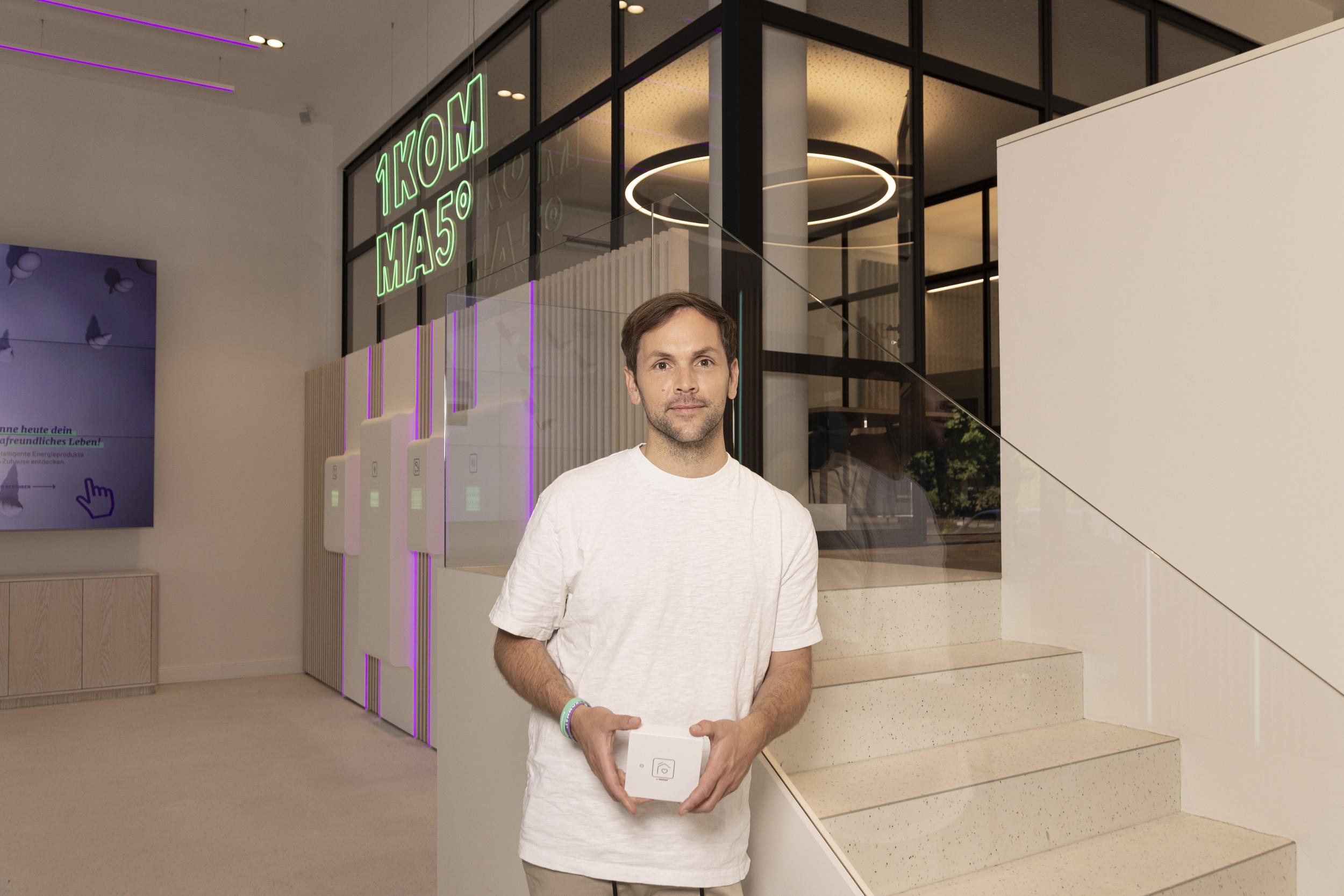
With Rabot Flow, Rabot Energy combines a dynamic electricity rate, a smart meter, and a plug-and-play battery storage system into an integrated solution.
According to the company, this allows households to reduce their energy costs by an average of 15 percent.
The system is expected to be delivered within three days. According to Rabot Energy, the battery storage system can be plugged into a standard outlet and activated via the app in about two minutes.
Ownership of a solar panel system is not required to use the service. This means the offering is explicitly aimed at people living in rental apartments as well.
This approach could significantly expand the target audience for flexible electricity storage. While battery storage systems have often been installed alongside a home’s own solar array in the past, Rabot Energy aims to make the system accessible regardless of whether a user owns a property or a PV system.
Millions of Households as a Virtual Power Plant
The long-term goal, however, goes beyond optimizing individual electricity bills.
Rabot Energy aims to connect many decentralized battery storage systems and controllable consumers into a virtual power plant (VPP).
A virtual power plant does not consist of a single large facility. Instead, numerous geographically distributed devices are coordinated via shared software.
If many households charge their storage systems during periods of high electricity production and reduce their grid electricity consumption when supply is tight, this can help cushion price spikes and make better use of renewable energy.
“The next generation of power plants won’t be built—they’ll be interconnected,” explains Jan Rabe, CEO of Rabot Energy.
The company is thus describing a fundamental shift in the energy system: In addition to the question of how much renewable electricity is generated, the timing of when it can be consumed or stored is becoming increasingly important.
45 Million Euros in Savings for Customers
According to Rabot Energy’s calculations, its customers will have saved a total of approximately 45 million euros in 2025 compared to the respective rates of their default providers.
This figure is a company estimate based on a specific benchmark and does not mean that every customer received a correspondingly lower rate compared to all alternative electricity tariffs.
For Rabot Energy, however, cost savings are an important component of its business model.
This is because the company aims to win over households not only by contributing to the energy transition but also by offering an immediate financial benefit.
The intelligent control of storage systems and consumers could amplify this effect in the future. However, this depends on the savings achieved justifying the costs of the necessary hardware and services.
One Million Customers as the Next Goal
With the 50 million euros, Rabot Energy aims to expand its customer base to one million in the medium term.
Customer Growth and Growth Target
Current customer base: +200,000
Target customer base: 1,000,000
The current customer base already accounts for more than one-fifth of the target. The goal has not yet been achieved. At the same time, the platform is set to integrate additional devices and expand its control functions. In addition to stationary battery storage systems, this includes, in particular, wall boxes and heat pumps. The business with commercial and industrial customers is also set to be further developed.
Endeit partner Sara Resvik highlights the combination of a core business that the investor describes as profitable and the technological capability to intelligently manage electricity demand.
For the DTCF, the focus is particularly on contributing to the flexibility of the energy system.
The energy transition is increasingly becoming a software issue
The funding round illustrates how business models in the energy sector are changing.
While many EnergyTech companies have so far focused on expanding renewable power generation or offering lower-cost rates, a new market is emerging around the smart control of decentralized energy systems.
With every additional electric car, battery storage system, and heat pump, the potential to shift electricity consumption over time grows.
However, the hardware required for this is only part of the solution. Software is becoming increasingly crucial, as it coordinates millions of individual devices while taking electricity prices, user needs, and technical limitations into account.
The transition from electricity provider to operator of a networked energy platform, however, also brings new challenges: devices from different manufacturers must be integrated, control decisions must be reliably implemented, and economic benefits for customers must be demonstrated over the long term.
The Series B funding round of 50 million euros therefore not only finances further customer growth. It is intended to facilitate the transition from a provider of dynamic electricity rates to a technology company that manages millions of decentralized energy systems as a shared infrastructure.
Whether this actually results in a virtual power plant on a relevant scale will depend primarily on how many customers actively connect their devices and how much controllable capacity Rabot Energy can thereby provide.









Newsletter
Startups, stories and stats from the German startup ecosystem straight to your inbox. Subscribe with 2 clicks. Noice.
LinkedIn ConnectFYI: English edition available
Hello my friend, have you been stranded on the German edition of Startbase? At least your browser tells us, that you do not speak German - so maybe you would like to switch to the English edition instead?
FYI: Deutsche Edition verfügbar
Hallo mein Freund, du befindest dich auf der Englischen Edition der Startbase und laut deinem Browser sprichst du eigentlich auch Deutsch. Magst du die Sprache wechseln?