The startup map is expanding

Berlin and Munich remain the cornerstones of the German startup landscape. These cities are home to investors, talent, networks, and a particularly large number of young companies. But focusing solely on these two major cities means overlooking part of the current startup momentum.
In the first half of 2026, 3,053 startups were founded in Germany. That was 52 percent more than in the second half of 2025. Startup numbers rose in all 16 federal states. With 429 new startups, Berlin remained the city with the highest number of new startups, though its growth rate of 21 percent was significantly slower than the national average. In terms of startups per capita, university towns such as Aachen, Potsdam, and Heidelberg rank high alongside Munich, Berlin, and Hamburg.
So there is certainly no sign of startups fleeing the major cities. Rather, the startup landscape is becoming more widespread.
Universities Are Becoming More Important
This aligns with a finding from the German Startup Monitor 2026. For 59 percent of the startups surveyed, the product is based directly or indirectly on new scientific findings. 51 percent of founders have received support from universities or research institutions. Of these, 70 percent rate this support as important or very important.
This changes the perspective on the startup landscape. Where research, talent, and businesses converge, relevant startup hubs can emerge—even beyond the well-known centers.
This is particularly interesting for Brandenburg. The state, together with Berlin, encompasses one of Germany’s largest startup hubs and also has its own universities, research institutions, industrial clusters, and a business landscape dominated by small and medium-sized enterprises. The challenge, therefore, is not just to foster new startups. It’s also about better connecting existing hubs with one another and with Berlin.
Brandenburg Is Building New Startup Hubs
The state of Brandenburg has been making targeted investments in this infrastructure for several years. One key component is new startup hubs, which are designed to support startups in the state as accelerators and to bring them into closer collaboration with universities, the business community, and investors.
One of these is the Reaktor Wildau, located southeast of Berlin. The accelerator is primarily aimed at startups in the fields of artificial intelligence, energy, and mobility, and is located in the immediate vicinity of the Technical University of Applied Sciences in Wildau. In addition to working with its own startup cohorts, Reaktor increasingly sees itself as a hub connecting founders, academia, established companies, and investors.
However, a single startup hub quickly runs up against geographical limits: a network in Wildau is, after all, just a network in Wildau.
That’s exactly how the idea for the “Startup Country Tour” came about.
Instead of waiting for founders from other parts of Brandenburg to come to Wildau, Reaktor takes startups, investors, and other stakeholders to them.
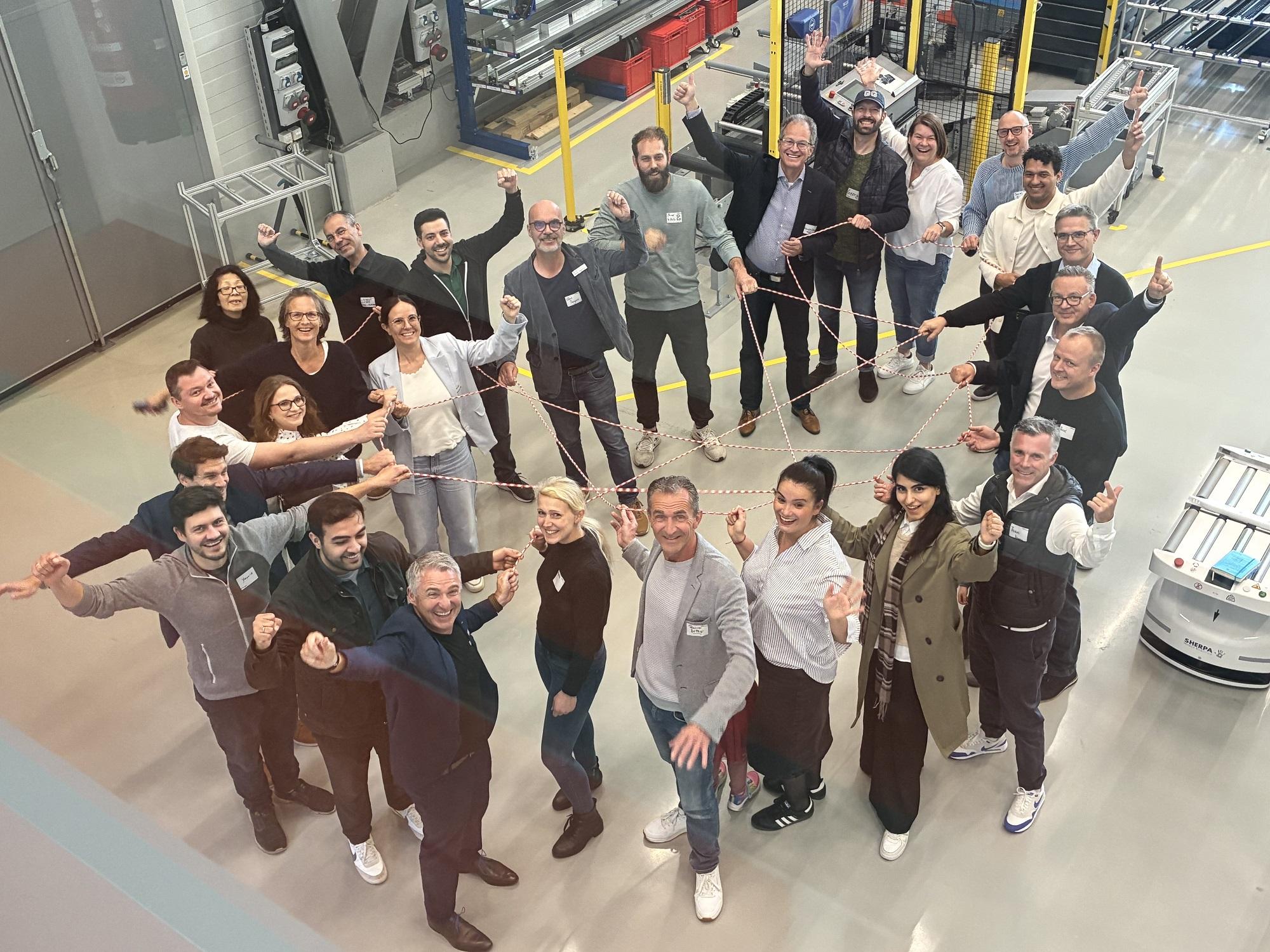
The direction of this exchange is crucial. The “Landpartie” is not just a simple tour during which an accelerator showcases its startups across the state. The teams traveling along are only part of the format. At least as important is the question of who is already founding companies, conducting research, investing, or running businesses at each destination.
The “Landpartie” thus becomes a kind of field research within its own ecosystem: What’s emerging in Neuruppin? What kind of community exists in Brandenburg an der Havel? Which companies and startups are based in Frankfurt (Oder)? And which of these are still unknown to the stakeholders from Wildau, Potsdam, or Berlin?
The stops so far show just how varied the answers are.
Neuruppin: Small Doesn’t Mean Invisible
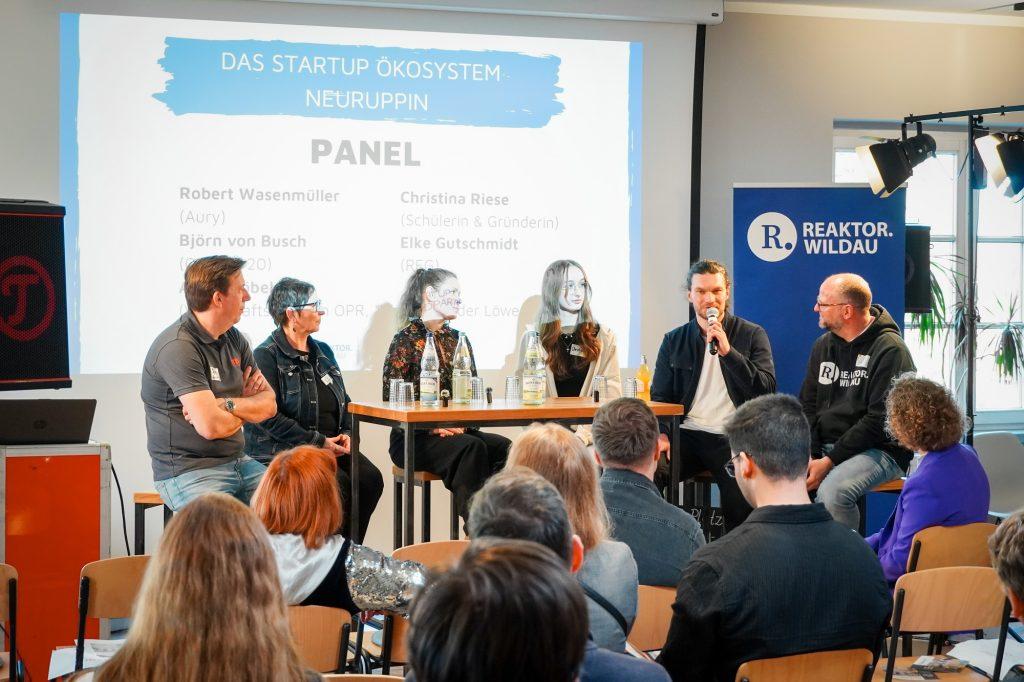
The first field trip took us to Neuruppin in March. The host was Quartier 20, a local coworking and community space. Startups pitched to investors, while discussions focused on financing, accelerators, and the regional startup ecosystem.
Almost more exciting than the pitches themselves was the insight into the local structures. In Ostprignitz-Ruppin, for example, there’s the “Schule der Löwen” (School of Lions), a startup competition that brings students together with regional companies and experienced founders.
Such initiatives rarely appear on the national startup map. But they demonstrate that startup culture doesn’t begin only where a large VC fund or a well-known accelerator is based.
The “Startup Landpartie” in Neuruppin was the first proof: an event originating in Wildau can successfully help foster dialogue between local and national networks.
Pitch am Beach: Out of the Conference Room
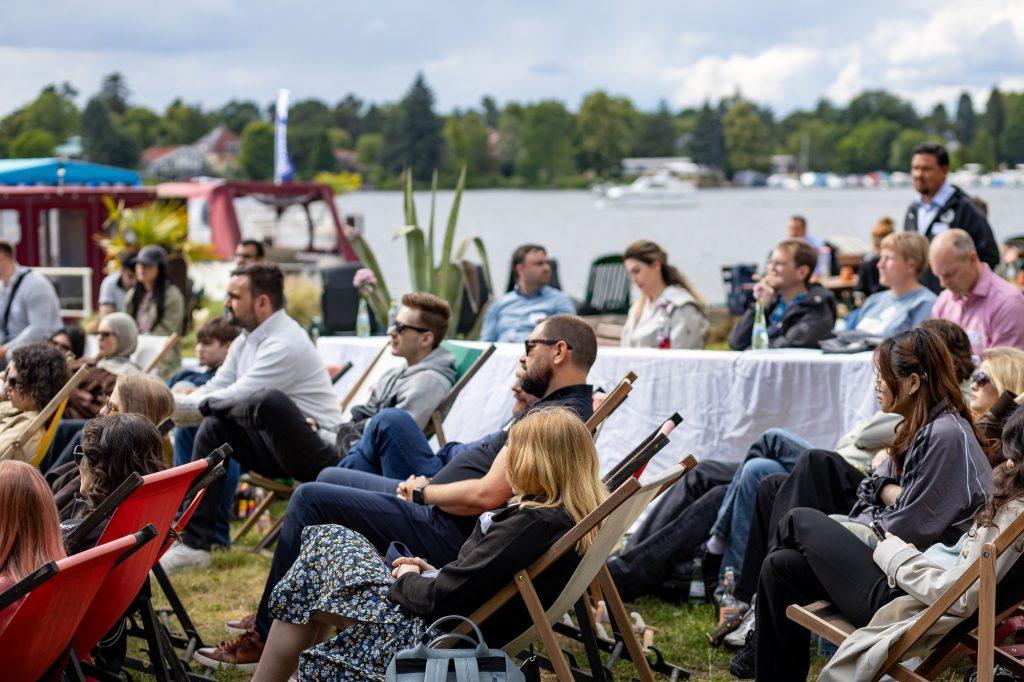
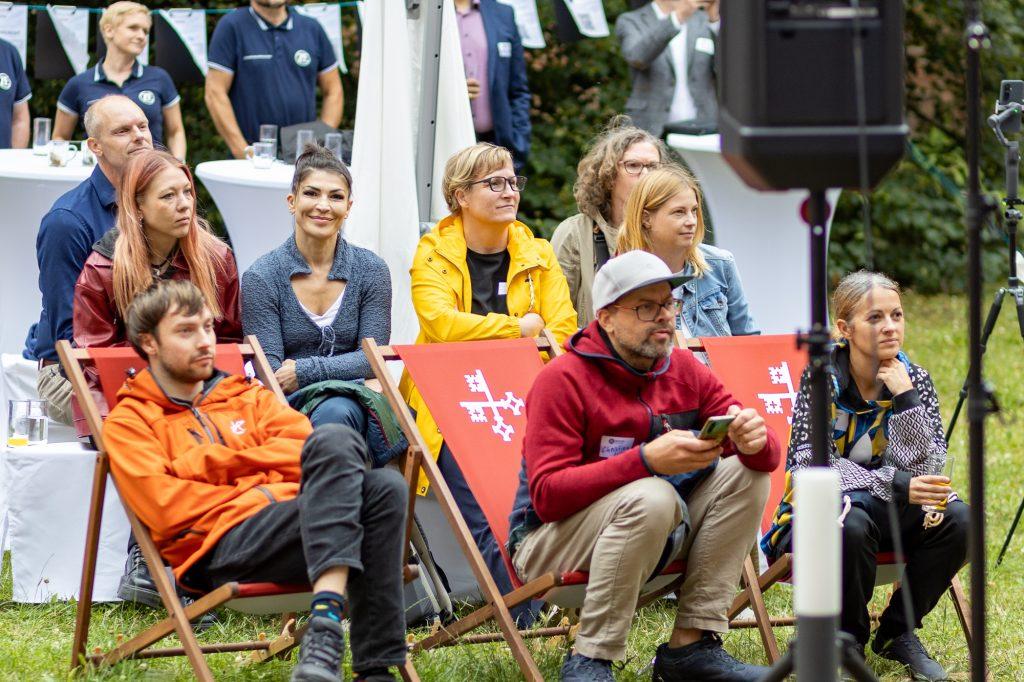
The second “Landpartie” took place in June at Lake Zeuthen. “Pitch am Beach” combined startup pitches with a funding and innovation marketplace. Up to ten startups had the opportunity to present themselves to investors and the regional ecosystem.
The location was more than just a backdrop. Many startup events follow a similar pattern: stage, panel, pitch, networking. At Lake Zeuthen, this format was deliberately broken up.
The goal is to bring together Brandenburg’s image as a tourist destination with its innovative side. Exciting pitches on the beach, surrounded by forests and nature. The idea behind it is this: An ecosystem isn’t made up solely of institutions and funding programs. It thrives when innovative people come together and think outside the box. This unusual setting makes that possible.
This is particularly relevant in the Berlin metropolitan area. For many founders, employees, and companies, the border between Berlin and Brandenburg doesn’t correspond to the boundaries of their networks in everyday life anyway.
Brandenburg an der Havel: First, see what’s already there
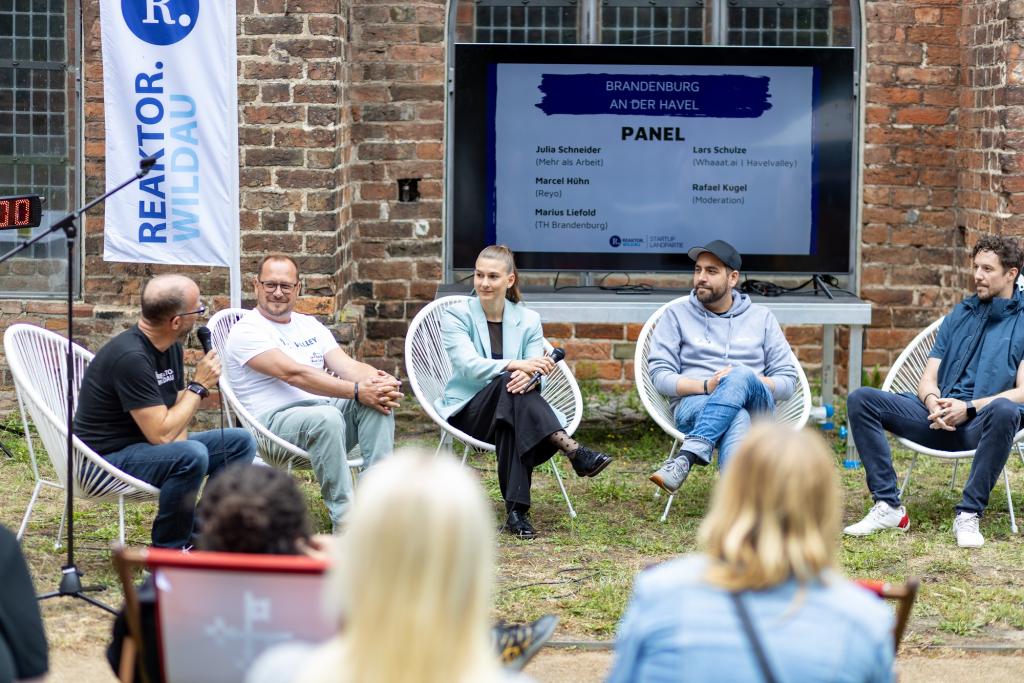
In July, the tour continued to Brandenburg an der Havel. Here, too, the group did not find a blank startup map.
The city and its surrounding area are home to exciting networks such as “HavelValley,” the co-working space “HavelSpace” that grew out of it, and, of course, the Brandenburg University of Applied Sciences with its associated startup initiatives.
The venue was remarkable. The Landpartie took place at the Brandenburg Cathedral. Cathedral Island is one of the most historically significant places in the state. This is where the “Brandenburg” was located—from which the city, the Margraviate, and today’s federal state derive their names; Brandenburg an der Havel is considered the cradle of the Margraviate.
And there’s even a connection to Berlin: a church dispute was settled in the cathedral’s hospital in 1237. The document on display there mentions a priest named “Symeon de Colonia” and is considered the earliest written evidence of Cölln, one of Berlin’s two medieval founding cities.
A place, then, where Brandenburg and Berlin were already connected long before anyone spoke of a startup ecosystem. The excursion brought the innovations of tomorrow to the very birthplace of the state.
Frankfurt (Oder): Looking East
The fourth “Landpartie” takes place on October 15 in Frankfurt (Oder). This adds a new dimension to the event.
On a map of Germany, Frankfurt lies on the eastern edge of Brandenburg. On a map of Europe, the perspective shifts. There, the city lies on a line that can be read as follows:
Berlin – Frankfurt (Oder)/Słubice – Poznań – Warsaw.
This is a shared startup ecosystem and an interesting economic and scientific axis. But it’s a system that has received relatively little attention in the German startup debate so far.
East of the Oder River lies a major technology market.
Dealroom estimated the value of the Polish tech ecosystem in 2025 at 56.5 billion euros. However, caution is advised when it comes to venture capital figures: Dealroom initially projected around 347 million euros for early 2025. Market data later published by PFR Ventures puts the total for the full year at around 800 million euros, which flowed into 166 innovative Polish companies.
This also illustrates how rapidly the market is developing on the Polish side.
There’s more than just a border between Berlin and Warsaw
Warsaw is by far the most prominent Polish hub. The Polish capital has the highest concentration of venture capital funds in the country; there are approximately 100 active VC firms there. At the same time, with around 258,500 students at 69 universities, Warsaw is Poland’s largest academic center.
But for the Berlin-to-Warsaw corridor, Poznań is of particular interest.
Wielkopolska, including Poznań, is listed as Poland’s fourth-largest startup hub in the city’s latest report. More than 200 startups are based in the region. In Poznań alone, approximately 2.3 billion złoty were spent on research and development in 2024. Patent applications were filed for 191 inventions, and 125 patents were granted.
This means that the route between Berlin and Warsaw is not merely a transit corridor. Along this route lie several university, research, and business hubs, each with its own strengths.
Frankfurt (Oder) and the immediately adjacent town of Słubice can play a special role in this regard. This has given rise to a cross-border startup corridor, though one that is not visible everywhere. That is precisely why the question is interesting.
After all, for a Brandenburg startup, internationalization doesn’t necessarily have to start with London or Silicon Valley. Poznań is closer. And for a Polish startup looking to enter the German market, the capital region lies right across the border.
The “Frankfurter Landpartie” thus proves that the format works not only within Brandenburg but also across the Oder River.
After getting to know each other comes financing
However, a “Landpartie” alone does not solve a fundamental problem facing regional startup ecosystems: while connections are quickly made at events, building capital relationships is significantly more difficult.
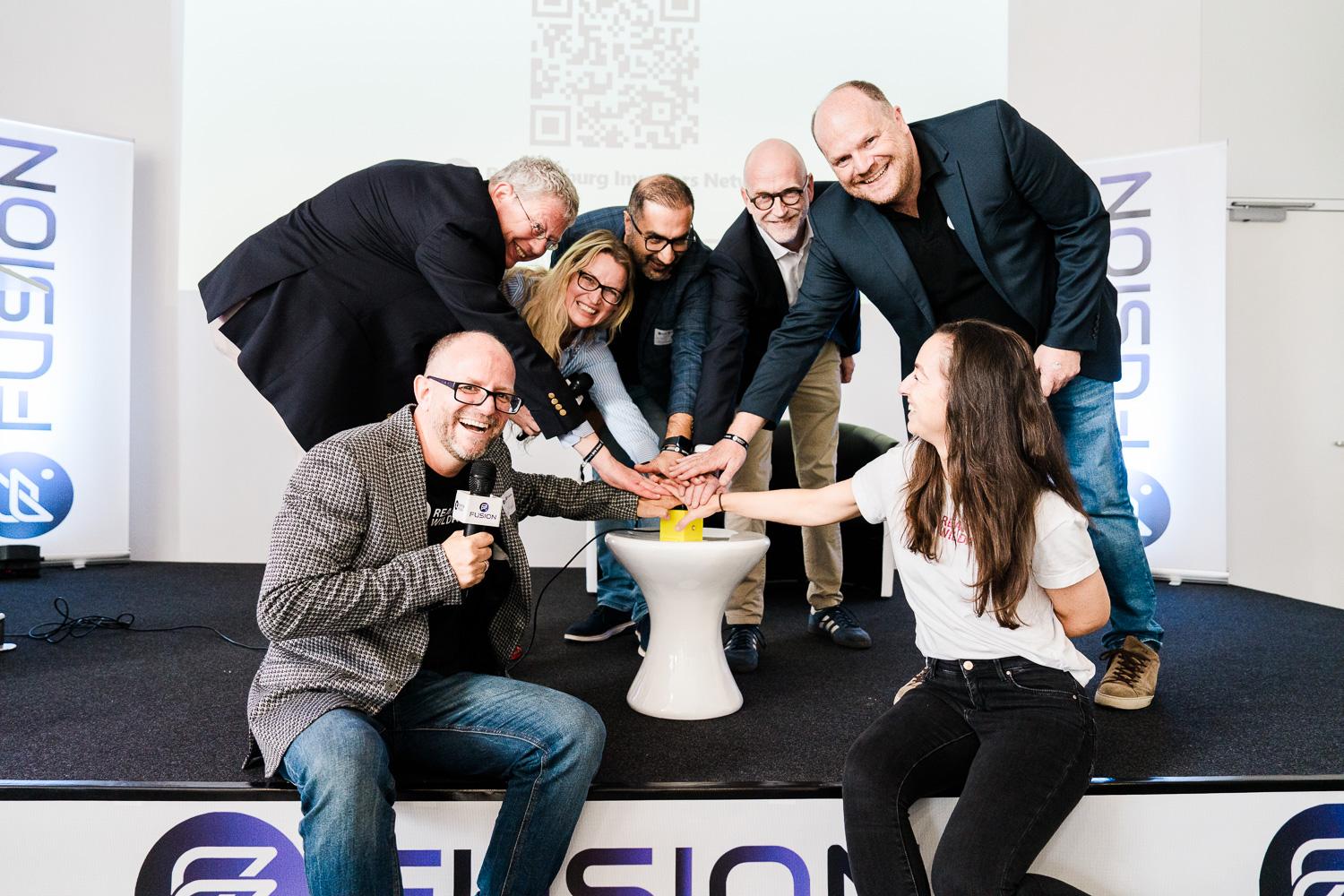
This is where a second initiative by Reaktor Wildau comes in. In September, the Brandenburg Investors Network (BIN) was launched at FUSION 2026. Its goal is to bring startups together with active and prospective business angels as well as other ecosystem stakeholders.
The connection between the two formats is obvious. At the “Landpartie” events, startups, entrepreneurs, and regional networks gain visibility; through the BIN, these connections can lead to contacts with investors.
Of particular interest here is the group of entrepreneurs who are not yet active as business angels. Especially outside the traditional VC hubs, there are people with capital, industry knowledge, and networks who can be at least as relevant to startups as institutional investors.
A small-to-medium-sized enterprise can become a pilot customer. An entrepreneur can get involved as a mentor—and perhaps later as an investor as well.
Whether this effort will succeed, however, remains to be seen. The BIN is still in its infancy. Nevertheless, it could become an important link for the “Landpartie”: The format would then be not just a series of events, but a way to permanently connect new parts of the ecosystem.
Not every city has to become Berlin
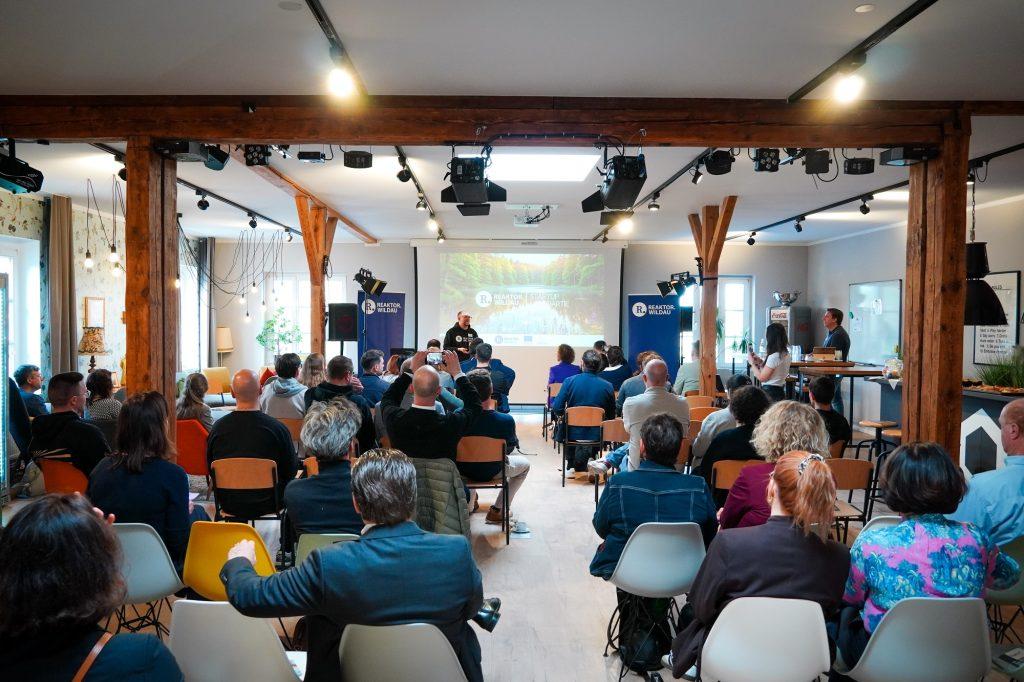
This may be the more interesting premise behind the “Startup Landpartie.”
If startup activity expands geographically, not every location needs to try to build a complete startup ecosystem modeled after Berlin’s.
A university town can provide research and talent. An industrial region can offer access to customers and manufacturing. Berlin brings capital, international networks, and a high density of startups. Border regions, in turn, can create access to neighboring markets.
What matters most, then, is not so much whether every location has everything, but whether the different strengths are connected with one another.
The Startup Landpartie is an attempt to forge precisely these connections. Whether this actually leads to collaborations, investments, or new companies is a more interesting metric than the number of visitors or pitches.
Where will the Startup Landpartie go in 2027?
Following stops in Neuruppin, Zeuthener See, Brandenburg an der Havel, and Frankfurt (Oder), the event is set to continue in 2027. To that end, Reaktor Wildau is seeking additional host locations.
It’s not just established startup hubs that are of interest. We’re looking for places where something has already taken root but has so far received little attention outside the region itself: university spin-offs, an active startup community, an industrial cluster, a technology center, a network of small and medium-sized businesses, or even another border region.
Startups, universities, economic development agencies, accelerators, companies, investors, and local initiatives can suggest locations for the next “Landpartie.”
The more intriguing question here isn’t which city has the largest startup ecosystem, but rather which connection is still missing.


Newsletter
Startups, stories and stats from the German startup ecosystem straight to your inbox. Subscribe with 2 clicks. Noice.
LinkedIn ConnectFYI: English edition available
Hello my friend, have you been stranded on the German edition of Startbase? At least your browser tells us, that you do not speak German - so maybe you would like to switch to the English edition instead?
FYI: Deutsche Edition verfügbar
Hallo mein Freund, du befindest dich auf der Englischen Edition der Startbase und laut deinem Browser sprichst du eigentlich auch Deutsch. Magst du die Sprache wechseln?