Up to five million euros per project: Federal government launches new funding program for digital technologies

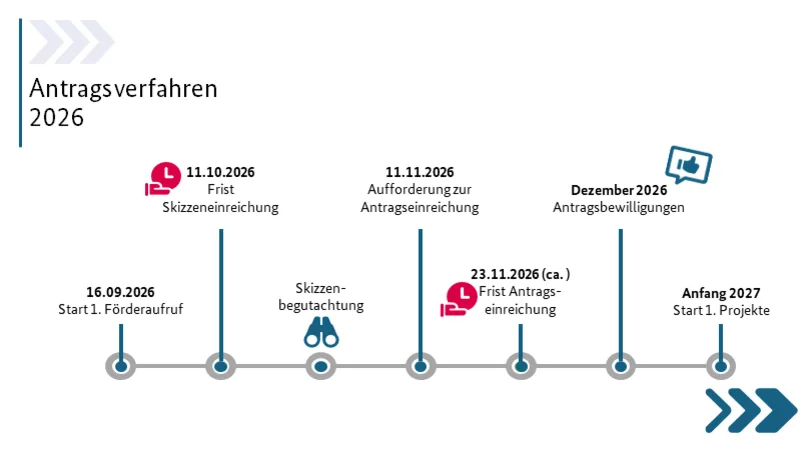
The federal government aims to shorten the path from digital research to a market-ready product. With the new “Digital-Tech-to-Product” funding program, the Federal Ministry for Digital Affairs and State Modernization (BMDS) is supporting startups and small and medium-sized enterprises in particular in further developing proven technologies to the pre-commercial market-ready stage. Up to five million euros in funding is available per project. The first call for proposals focuses on artificial intelligence, data ecosystems, cybersecurity, and cloud and edge computing. Applications will be accepted through October 11, 2026.
The program addresses a well-known challenge facing Germany as an innovation hub: While Germany has a strong research landscape, technological developments do not automatically result in companies and products that can scale internationally. Digital-Tech-to-Product therefore deliberately begins after the early research phase.
From Proof of Concept to Market-Ready Product
The focus is not on new basic research projects, but on technologies whose fundamental feasibility has already been demonstrated.
Funding is primarily directed toward product-oriented innovation projects that are to be further developed to Technology Readiness Level 8 (TRL 8) following a successful technology demonstration. In this way, the program addresses the phase between functioning technology and pre-commercial market readiness.
The BMDS can provide up to five million euros per project. Projects at an earlier stage of development following a proof of concept—roughly at TRL 4 or 5—may also be considered in individual cases, but they are not the primary focus.
Federal Minister for Digital Affairs Dr. Karsten Wildberger sees a particular need for action when it comes to translating research into scalable technology companies. Germany is among the frontrunners in research and development, he notes. The key now, he says, isto “translate this strengthinto innovations and scaling tech companies.”
Startups and SMEs Take Center Stage
The program is aimed specifically at startups as well as small and medium-sized enterprises. Applications may be submitted either as individual projects or jointly with other partners as part of a consortium. In principle, Digital-Tech-to-Product is technology-neutral. However, the specific technological focus areas will be defined through individual calls for proposals.
The first call focuses on four areas: artificial intelligence and AI-based solutions, data ecosystems, cybersecurity and cryptography, and cloud and edge computing. In doing so, the BMDS is primarily focusing on technologies considered relevant to both the economic competitiveness and the technological independence of Germany and Europe.
“Market Pull” Instead of “Technology Push”
The BMDS explicitly states the principle of “market pull instead of technology push” in its funding rationale. Thus, it is not enough to develop a technically interesting solution and then search for a potential use case. Applicants must address a specific problem in the economy or society and demonstrate a clear need for their technology.
Accordingly, companies must present a plan for a business model, commercialization, and market launch as early as the application stage. The funding is thus intended to address precisely the phase in which a research or development project must be transformed into an actually marketable product.
Digital sovereignty becomes a selection criterion
In addition to market potential and technical innovation, digital sovereignty plays a central role. Applicants are expected to transparently present their technology stack and explain how their solution can contribute to greater resilience, technological self-determination, or reduced dependence on non-European providers.
This means that technological sovereignty is not merely formulated as a political goal but becomes a direct criterion for the allocation of funding. The BMDS lists four key selection criteria: business model and market potential, digital sovereignty, innovativeness, and implementation approach.
For startups in particular, it will likely be crucial to demonstrate just how concretely their technology contributes to European value creation and to more resilient digital infrastructures.
Application deadline is October 11
The first call for proposals is already underway. Interested companies and consortia can submit their project outlines until October 11, 2026. The process consists of two stages. First, a project outline is submitted digitally via the “easy-Online” application system. Companies whose concepts receive a positive evaluation are then invited to submit a complete grant application.
Funding consulting services are provided by TÜV Rheinland Research and Innovation Management and VDI/VDE Innovation + Technik. According to the ministry, additional calls for proposals are expected to follow in the coming months.
Five million euros can help bridge the gap to Series A
For startups, the scale of funding is particularly appealing. Up to five million euros per project can make a significant difference, especially for capital-intensive digital technologies. The program addresses a phase that can be particularly challenging for young technology companies: While the proof of concept works, product development, integrations, certifications, infrastructure, or resources for pilot projects are still lacking for broad commercial use.
Private investors, on the other hand, often expect clear evidence of product-market fit and scalable revenue. A funding gap can arise precisely between these two stages of development. Digital-Tech-to-Product aims to mitigate part of this risk through public funding, though with a clear expectation of subsequent commercialization.
What happens after funding is key
In this way, the BMDS addresses a key aspect of German innovation policy. It is not the number of research projects alone that determines whether Germany can keep pace in international technological competition. What matters is how often research leads to competitive products and technologies lead to scaling companies.
The “market pull rather than technology push” approach is therefore noteworthy. Instead of primarily funding technological development, the focus is on a specific market from the very beginning.
Up to five million euros in public funding can help companies navigate a difficult development phase. In the long term, however, the program’s success will have to be measured by how many of the funded projects actually acquire customers, mobilize private growth capital, and scale internationally after reaching TRL 8. After all, digital sovereignty ultimately does not arise solely from developing technologies in Germany. It also arises when these efforts give rise to companies whose products can hold their own in international competition.

Newsletter
Startups, stories and stats from the German startup ecosystem straight to your inbox. Subscribe with 2 clicks. Noice.
LinkedIn ConnectFYI: English edition available
Hello my friend, have you been stranded on the German edition of Startbase? At least your browser tells us, that you do not speak German - so maybe you would like to switch to the English edition instead?
FYI: Deutsche Edition verfügbar
Hallo mein Freund, du befindest dich auf der Englischen Edition der Startbase und laut deinem Browser sprichst du eigentlich auch Deutsch. Magst du die Sprache wechseln?