UnternehmerTUM, Microsoft, NVIDIA, and Infineon Launch an Accelerator for Physical AI Startups

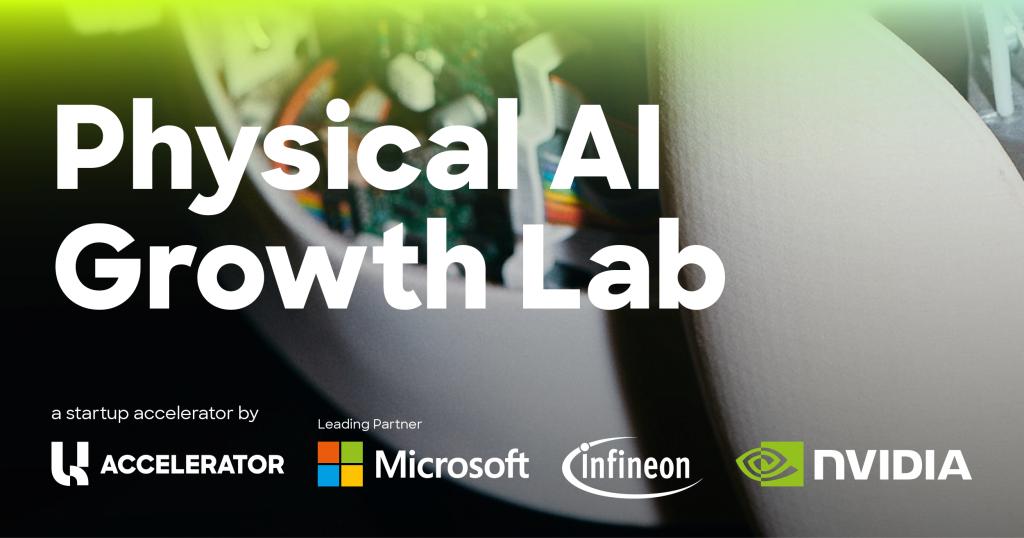
UnternehmerTUM Accelerator, Microsoft, Infineon Technologies, and NVIDIA are jointly launching the “Physical AI Growth Lab.” The four-month support program is designed to help young technology companies bring applications in the fields of robotics, physical AI, and industrial artificial intelligence to market and scale them up. Participation is free for selected startups and does not require them to give up any equity. A total of 10 to 15 teams are expected to be accepted. Applications are open through November 13, 2026, and the program begins in January 2027.
New Accelerator for Robotics and Industrial AI
With the Physical AI Growth Lab, four established players from the European technology and innovation ecosystem aim to accelerate the development of young companies in the field of Physical AI. The program is initiated by the Munich-based UnternehmerTUM Accelerator. Microsoft, NVIDIA, and Infineon Technologies are participating as technology partners. The program is aimed at startups that combine artificial intelligence with physical systems and develop corresponding solutions for industrial applications. These include, for example, intelligent robots, autonomous machines, and AI-powered automation systems. The focus is on further developing existing technological approaches into commercially viable products. The selected teams will gain access to technical infrastructure, specialized experts, potential corporate clients, and investors. The program runs from January through April 2027 and combines digital offerings with in-person events in Munich. Participation is free of charge. UnternehmerTUM and the participating partners do not require any equity stakes as part of the program.
Ten to 15 startups will be accepted
The Physical AI Growth Lab is aimed at young companies from Europe, the Middle East, and Africa, as well as startups developing solutions for these regions. To apply, teams must meet certain requirements. The company must be no more than three years old and have no more than 20 employees. In addition, the team must include at least one technical co-founder. Another requirement is a functional prototype or a Minimum Viable Product (MVP). The program is thus aimed at companies that have already completed initial technical development work and now want to further develop their products or scale them commercially. A total of 10 to 15 startups are expected to be selected. The application period is already underway. Interested founding teams can apply through November 13, 2026. The announcement does not provide details on a specific application link or the exact selection process.
Microsoft is providing $350,000 in Azure credits
A key component of the program is access to powerful cloud and AI infrastructure. Through Microsoft for Startups, participating companies will receive benefits, including Azure credits valued at $350,000. These credits can help startups utilize computing resources and cloud services to develop their applications. Significant computing capacity may be required, particularly in the field of Physical AI. This includes, for example, training AI models, processing large volumes of sensor data, and simulating physical processes. In addition to its Azure infrastructure, Microsoft is also contributing contacts from its international corporate network. The Azure credits mentioned are in-kind benefits or usage credits and do not constitute a direct cash payment or equity financing. The announcement does not specify the exact terms of use for the credits.
NVIDIA Supports AI Training, Simulation, and Robotics
With NVIDIA, another major technology provider is joining the Accelerator. The company is offering selected startups access to software development kits, open models, and offerings from the NVIDIA Inception program. The focus is on technologies required for the development and operation of physical AI systems. These include AI training, simulation, and the execution of models directly on devices and machines. The integration of these areas plays a central role, particularly for robotics applications. AI systems must sense their environment via sensors, process information, and derive appropriate actions from it. Simulations can help test certain processes virtually before they are implemented in real machines. NVIDIA plans to provide participating startups with tools from its technology portfolio for this purpose. The specific hardware resources or individual development services to be provided were not specified.
Infineon Supplies Semiconductors and Sensors for Physical AI
While Microsoft and NVIDIA primarily provide cloud, AI, and simulation infrastructure, Infineon Technologies contributes its expertise in semiconductor development. The company aims to give the startups access to hardware components required for intelligent physical systems. These include microcontrollers, sensors, power electronics, power supply technologies, and connectivity solutions. These components are relevant, for example, for controlling robots, processing sensor data, and connecting industrial devices. The program thus covers both software development and key areas of the underlying hardware. This integration can be important for startups, as the development of physical AI products often requires the coordination of different technical systems. An AI model alone is not sufficient to operate an autonomous robot or an intelligent machine. Additional requirements include suitable sensors, control units, electrical components, and reliable communication interfaces.
UnternehmerTUM Opens Its Investor and Industry Network
In addition to the technological infrastructure, access to potential customers and investors is another key focus. According to UnternehmerTUM Accelerator, the program draws on a network of more than 170 mentors and over 200 investors. This is intended to provide participating startups with contacts to experts in technology, business development, and financing. In addition, there are direct connections to corporate clients who may serve as potential development partners or early adopters. Access to industrial application partners is particularly important for young robotics companies. The development and testing of such systems often require real-world operating environments and close collaboration with future customers. UnternehmerTUM points to former accelerator companies such as Sereact, RobCo, and Sewts, which are also active in the fields of robotics and industrial automation. According to UnternehmerTUM, startups from its accelerator have already raised a total of nearly four billion euros in funding. This figure represents the funding raised to date by companies from the accelerator ecosystem and does not represent capital allocated to the new Physical AI Growth Lab.
Physical AI Connects AI with the Real World
Physical AI refers to artificial intelligence applications that interact with their physical environment. While many traditional AI applications primarily process digital information, physical AI systems must also take into account real-world movements, spatial relationships, and technical processes. Typical areas of application include robotics, industrial automation, autonomous systems, and smart logistics. A key technical challenge lies in integrating AI models with sensor technology, simulation, and machine control. The systems must capture information from their environment and use it to derive actions that function reliably under real-world conditions. The initiators of the accelerator see significant growth opportunities in this area for European technology companies. The announcement cites an expected European share of approximately 22.5 percent of the global physical AI market by 2026. This is a market forecast. The underlying market definition and calculation method are not explained in detail in the announcement. The actual market share depends, among other things, on which technologies and applications are classified under Physical AI.
From Research to Industrial Application
With the new program, the partners aim in particular to support the phase between technical development and commercial scaling. For many deep-tech startups, this transition is challenging. A functioning prototype must be tested under real-world conditions, further developed, and integrated into existing industrial processes. To do this, companies often need specialized hardware, computing capacity, and access to experienced industry partners. In addition, they must acquire their first customers and raise capital for further development. The Physical AI Growth Lab brings together various resources to support these efforts. Microsoft provides cloud infrastructure; NVIDIA supports AI and simulation tools; Infineon contributes hardware components; and UnternehmerTUM offers mentoring, corporate partnerships, and investor contacts. Inga vom Holtz, Director of Startups & Investments at UnternehmerTUM, sees this collaboration as an opportunity to make it easier for young companies to access key development resources. The goal is to support Physical AI startups from the EMEA region in building scalable business models.
Applications due by November 13, 2026
The first cohort of the Physical AI Growth Lab will begin in January 2027 and end in April. The program will be conducted in a hybrid format and will include in-person sessions in Munich. Ten to 15 startups with existing prototypes or initial market-ready product versions will be selected. For participating companies, the primary benefit lies in the combination of technical infrastructure, industrial expertise, and access to potential customers and investors. Through this joint accelerator, UnternehmerTUM, Microsoft, NVIDIA, and Infineon aim to accelerate the development of European physical AI companies. Whether this leads to the emergence of successful technology companies in the long term will depend, in particular, on how many teams are able to translate their solutions into commercial applications after the program. The application deadline is November 13, 2026.










FYI: English edition available
Hello my friend, have you been stranded on the German edition of Startbase? At least your browser tells us, that you do not speak German - so maybe you would like to switch to the English edition instead?
FYI: Deutsche Edition verfügbar
Hallo mein Freund, du befindest dich auf der Englischen Edition der Startbase und laut deinem Browser sprichst du eigentlich auch Deutsch. Magst du die Sprache wechseln?