Germany's Economy Under Pressure: Manufacturing and Services Are Slowing, and Small and Medium-Sized Businesses Are Considering Relocating

The latest economic data paint a challenging picture for Germany as a business location. While production in the manufacturing sector declined again in July 2026, the Federal Statistical Office also reported falling real revenues in the service sector. At the same time, a study by KfW Research shows that an increasing number of export-oriented small and medium-sized enterprises are considering relocating their operations abroad. This trend is particularly pronounced in the manufacturing sector.
These three developments are not directly comparable with one another and, in some cases, refer to different time periods. Taken together, however, they show that economic pressure has now spread to both the industrial and service sectors, and that companies are increasingly responding to changing international conditions.
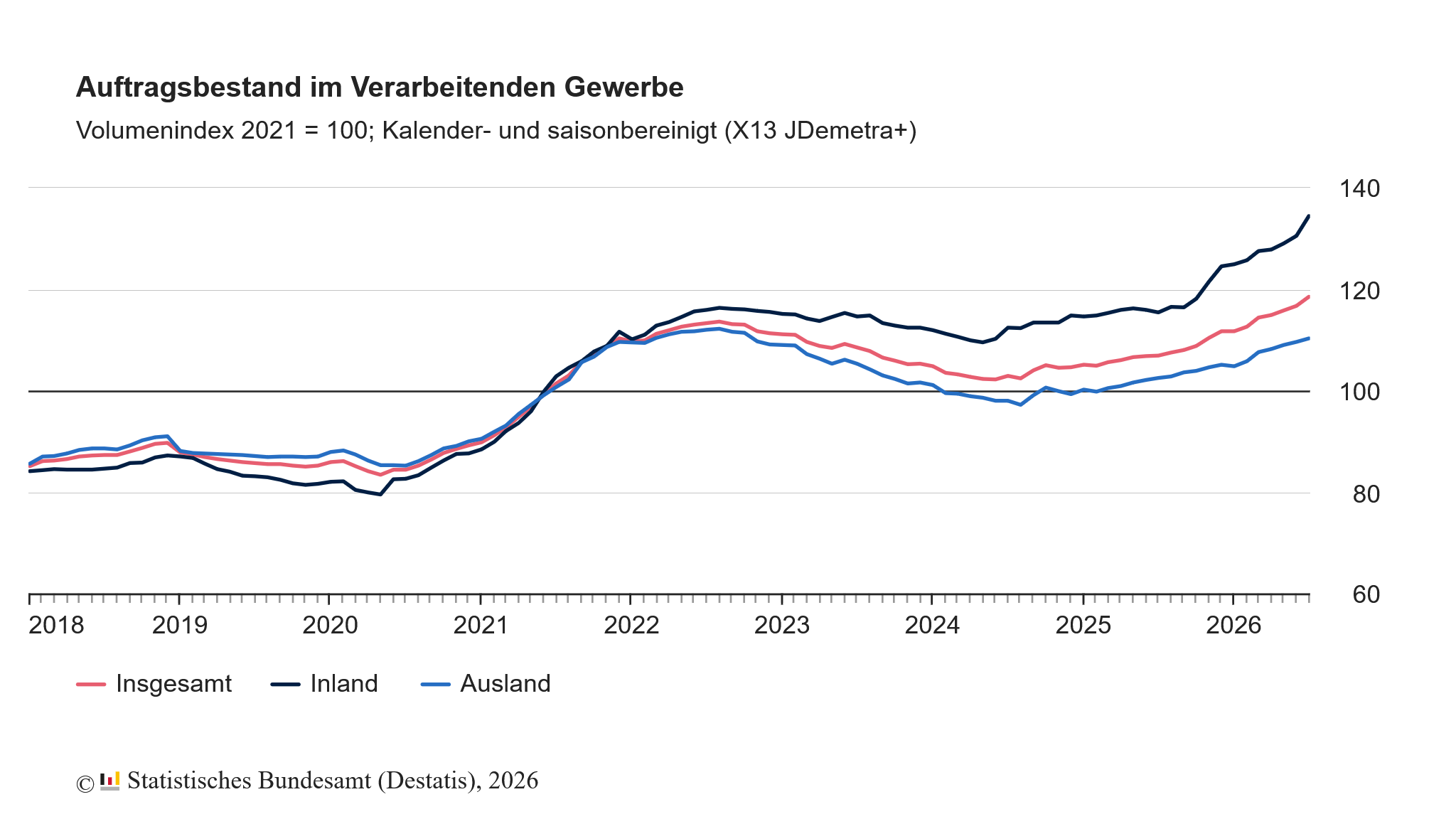
Production Falls by 1.1 Percent in July
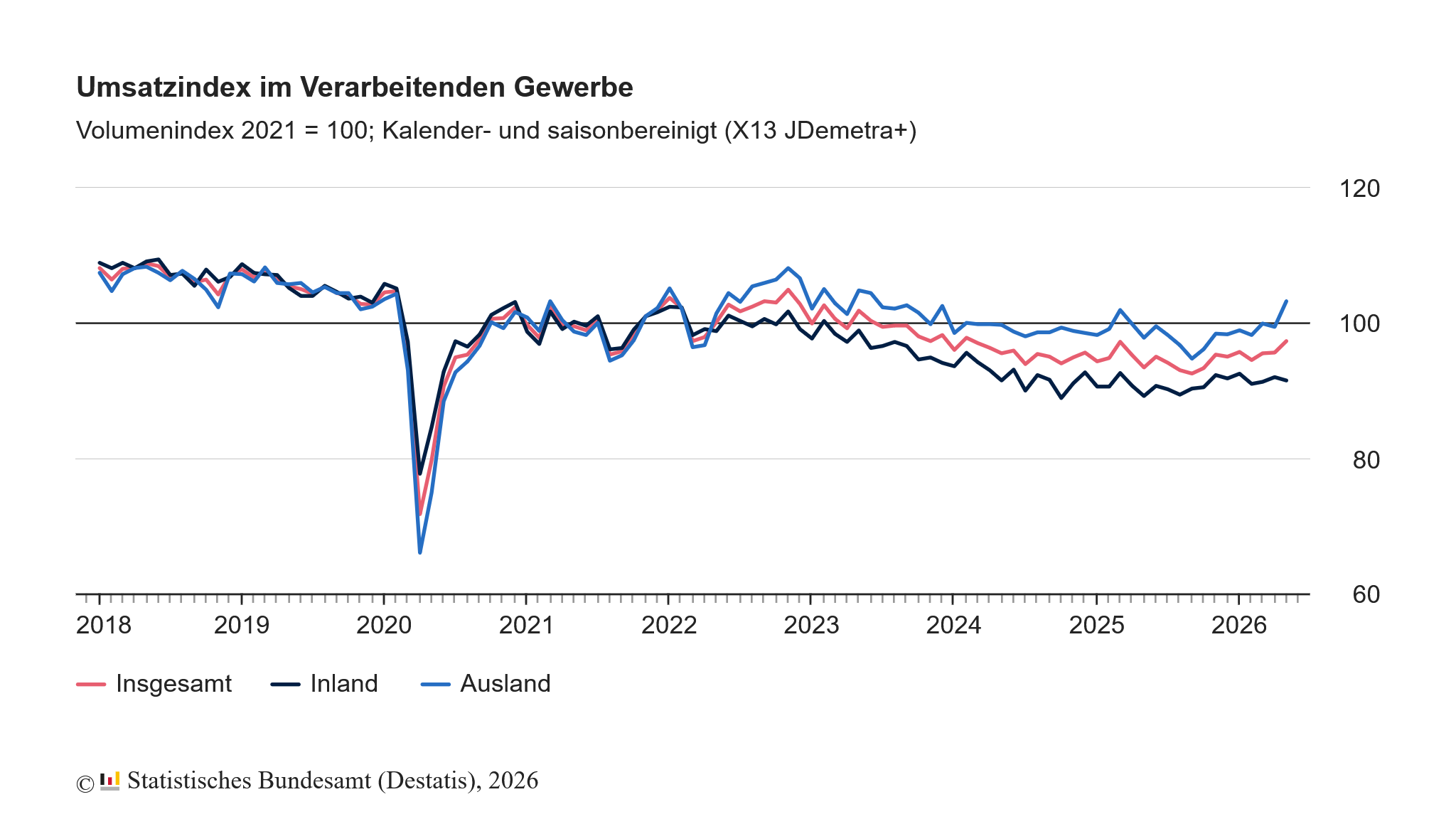
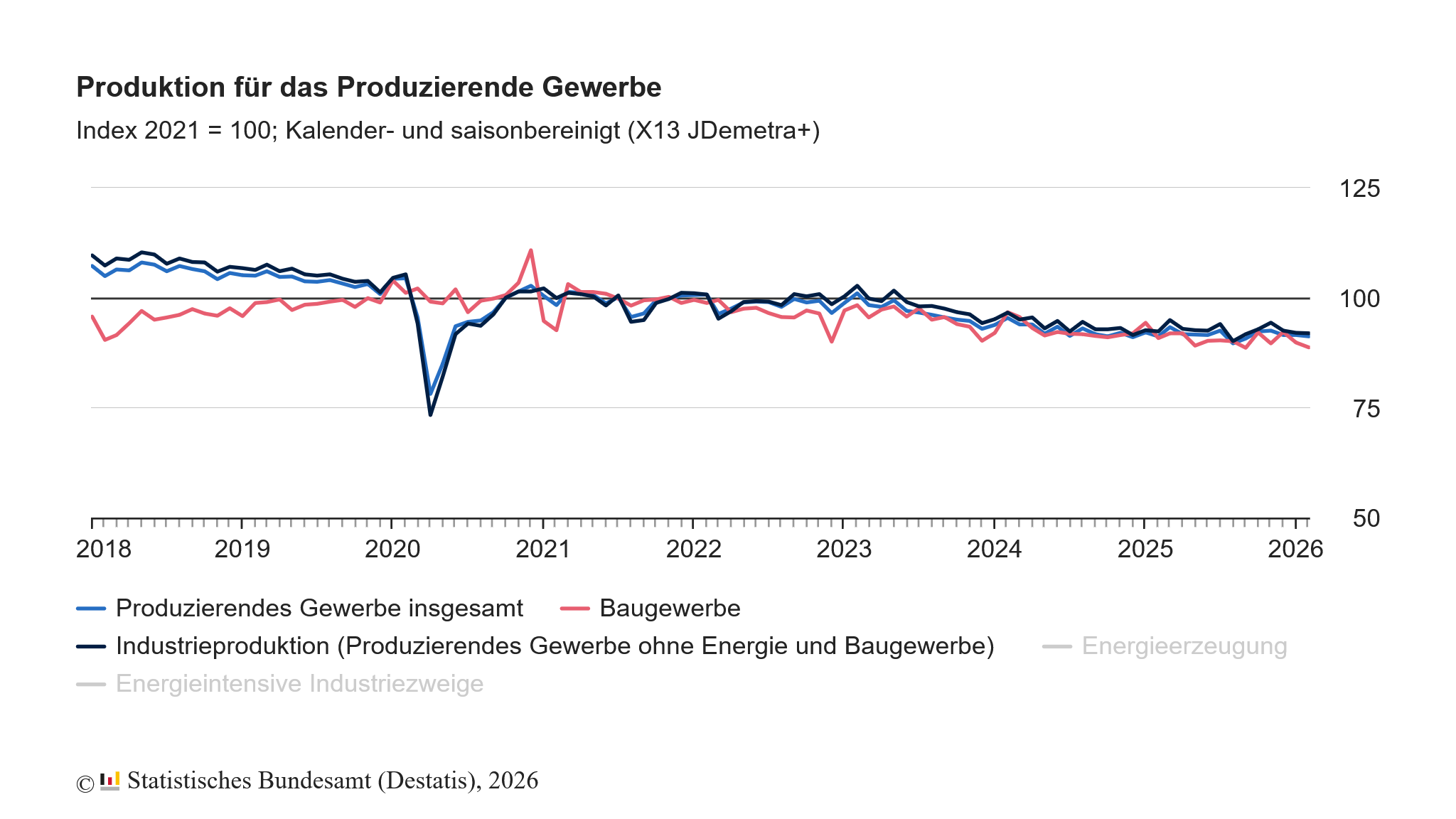
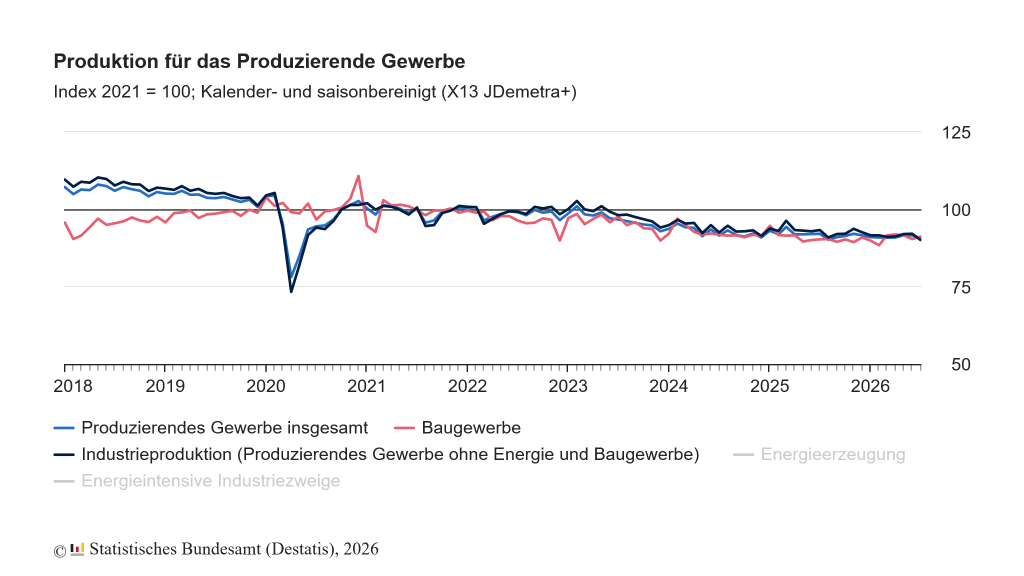
Real production in the manufacturing sector fell by 1.1 percent in July 2026 compared with the previous month, after seasonal and calendar adjustment. Compared to July 2025, the decline was 1.6 percent. The revised June figures also offer little cause for optimism. Instead of the initially reported 0.2 percent increase, production remained flat compared to May.
The only slightly more positive indicator is the three-month comparison, which is less prone to fluctuations. Between May and July, production was 0.4 percent above the level of the previous three months. However, actual industrial production—that is, the manufacturing sector excluding energy and construction—showed a significantly weaker trend. It fell by 2.2 percent in July compared with June and was 3.3 percent below the level of the previous year.
Automotive Production Plummets by 9.2 Percent
The decline was particularly pronounced in the German automotive industry. Seasonally and calendar-adjusted, its production fell by 9.2 percent in July compared to the previous month. However, caution is needed when interpreting these figures. Destatis cites a production halt lasting several weeks as a key factor. The monthly figure alone therefore does not allow for conclusions about a corresponding sustained slump in demand.
Nevertheless, the figure comes amid a challenging environment for Germany’s key industry. Production of capital goods also declined by 3.4 percent overall in July. Consumer goods recorded a 2.2 percent decline, and intermediate goods fell by 0.2 percent. Energy production bucked the trend with a 4.7 percent increase. Wind power and photovoltaics contributed significantly to this. Construction output also rose by 0.9 percent.
Energy-Intensive Industries Remain Weak
Destatis also reported a decline for energy-intensive industries. Production fell by 1.7 percent in July compared to June.
On a three-month basis, it remained flat, and compared to July 2025, there was a 0.5 percent decline.
This means that the very sector of industry for which energy prices play a particularly significant role in international competitiveness remains under pressure.
Services Also See a Real Decline in Revenue
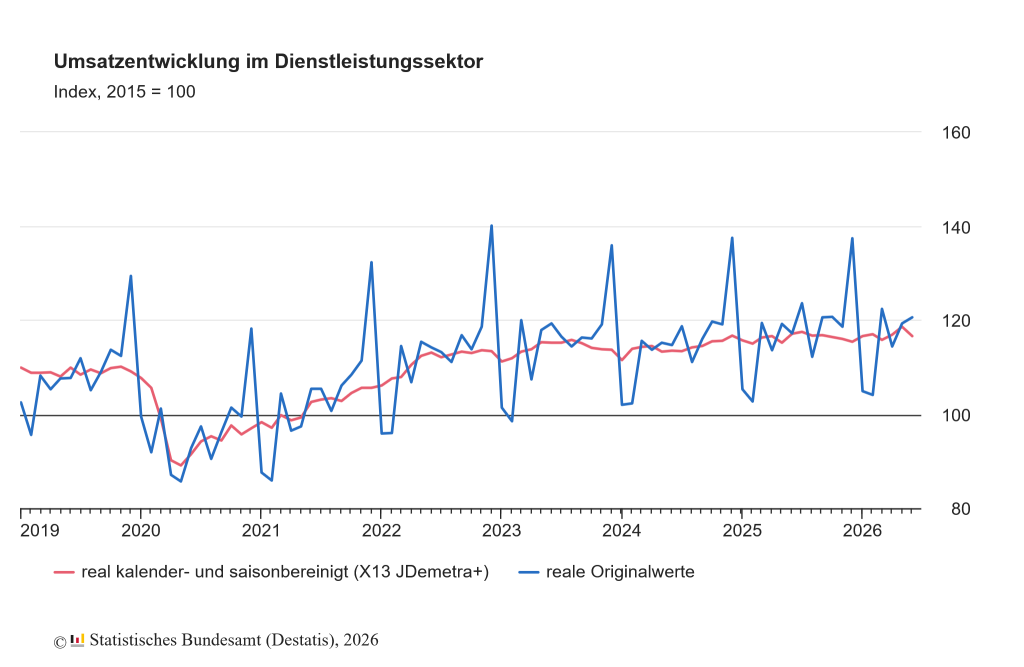
However, the weakness is not limited to industry. In the German services sector, excluding financial and insurance services, real revenue fell by 1.7 percent in June 2026 compared with May, after seasonal and calendar adjustment.
In nominal terms, the decline was 1.4 percent.
The comparison with the previous year is particularly interesting: Compared to June 2025, nominal revenue was 2.7 percent higher, but in real terms it declined by 0.4 percent. The higher revenue in euros therefore does not translate into real growth when adjusted for inflation.
On a month-over-month basis, professional, scientific, and technical services were hit the hardest, with a real decline of 2.3 percent.
Real estate and housing lost 1.8 percent. Transportation and warehousing, as well as other business services, each posted a decline of 1.6 percent. Even information and communication recorded a decline of 1.3 percent.
SMEs Expect Headwinds in International Business
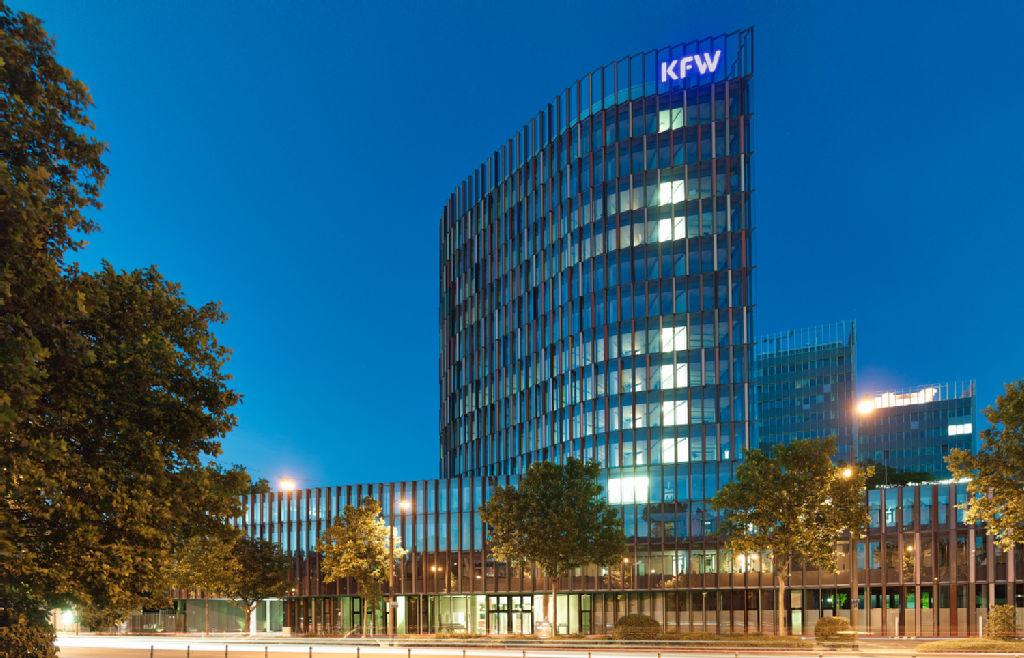
In line with the latest economic data, a study by KfW Research shows that the outlook for many internationally active SMEs is also darkening.
Thirty percent of German SMEs with international business expect cross-border sales to decline over the next three years. Six percent even anticipate a sharp decline. In contrast, just under a quarter expect growth, while 47 percent expect international sales to remain largely unchanged.
The survey was conducted in January 2026. The results therefore reflect the companies’ assessments at that time. International business is significant for a substantial portion of the German economy. Of the nearly 3.9 million SMEs, approximately 21 percent were active internationally in 2024. In the manufacturing sector, the share was significantly higher at about 46 percent. Foreign sales by small and medium-sized enterprises totaled 699 billion euros in 2024. In nominal terms, they remained flat compared to the previous year; adjusted for inflation, they declined by 2.9 percent.
Companies Are Seeking New Markets
Companies are already responding to geopolitical conflicts, trade policy uncertainties, and intensified international competition. Just under 16 percent of internationally active SMEs have tapped into new export markets or gained additional customers abroad within the past five years. Another seven percent are planning to take such a step.
At the same time, the importance of the European single market is growing. According to KfW, roughly twice as many companies are planning to focus more strongly on the EU. The pressure to adapt is particularly high in the manufacturing sector, which accounts for about 43 percent of SME foreign sales.
29 percent of industrial companies are considering relocating
However, the most striking figure from the KfW study does not concern new sales markets, but rather the production location itself. Over the past five years, only four percent of all SMEs active abroad had relocated operations overseas. Twelve percent now plan to do so over the next five years. In the manufacturing sector, the figure is even significantly higher: 29 percent of the SMEs active abroad surveyed plan to relocate at least some of their operations abroad.
This is a concerning development for growth and prosperity in Germany.
Dr. Dirk Schumacher, KfW Chief Economist
Not all of these plans will be carried out. KfW Research therefore estimates, for example, that a 50 percent implementation rate is likely. Even under this assumption, around seven percent of SME manufacturing companies could relocate part of their production abroad within five years.
Dr. Dirk Schumacher cites reducing bureaucracy, lower energy and labor costs, and lower taxes and fees as key levers for change.
No single crash, but several warning signs
A 1.1 percent decline in monthly production or weaker service sector revenue does not, in and of itself, constitute evidence of a new fundamental economic crisis. Monthly data fluctuates; production stoppages can have a significant impact on individual sectors, and the three-month comparison—showing a 0.4 percent increase—paints a more nuanced picture.
The combination of these signals is more problematic. Industrial production is 3.3 percent below the same month last year. The services sector is seeing a real decline in revenue. Price-adjusted, foreign revenue for small and medium-sized enterprises (SMEs) has recently declined. At the same time, significantly more industrial companies are considering the possibility of relocating operations abroad.
As a result, the debate over business locations is increasingly shifting from abstract sentiment indicators toward concrete business decisions. For Germany, therefore, it is likely to be less crucial whether individual monthly figures return to positive territory this fall. The more important question in the long term is where companies will build their next plants, where they will invest, and where new jobs will be created in the future.
If a growing proportion of small and medium-sized industrial firms no longer automatically answer this question with “Germany,” economic weakness will increasingly turn into a structural location problem. The country’s entrepreneurs and startups must also do their part here and ensure that the relevant investments generate real value creation and, thereby, provide the necessary support for the labor market.

Newsletter
Startups, stories and stats from the German startup ecosystem straight to your inbox. Subscribe with 2 clicks. Noice.
LinkedIn ConnectFYI: English edition available
Hello my friend, have you been stranded on the German edition of Startbase? At least your browser tells us, that you do not speak German - so maybe you would like to switch to the English edition instead?
FYI: Deutsche Edition verfügbar
Hallo mein Freund, du befindest dich auf der Englischen Edition der Startbase und laut deinem Browser sprichst du eigentlich auch Deutsch. Magst du die Sprache wechseln?