From a drone hobby to a digital inspection platform: How RK Droneview keeps an eye on energy facilities and real estate

Startbase supports startups from Reaktor Wildau – today: RK Droneview
Startbase continues its exclusive series on the startups from the second batch of the Reaktor Wildau accelerator. Every Saturday, we’ll feature one of the 14 participating companies and follow its progress throughout the program. We’ll focus not only on innovative technologies and business models, but also on the people behind them, the challenges they face, and the next steps on their journey to becoming successful companies.
Following Boomerent and MOVOLTA, today’s spotlight is on RK Droneview is in the spotlight. Founder Robin Krüger aims to fundamentally transform the inspection of real estate and energy facilities using drone technology and a digital platform. His approach: rather than reacting only after damage occurs, systematically assess the condition of facilities, document changes, and identify early on where action is needed.
What began as a one-person business born out of a personal passion for drones has since evolved into a technology-driven startup with ambitious growth plans. RK Droneview has already secured its first customers, is generating revenue from inspection services, and is simultaneously building a digital platform for assessing the condition of large facility portfolios.
Reaktor Wildau played an important role in this development. The accelerator program changed Krüger’s perspective on his business model. He has since hired his first employee, is preparing to bring on a co-founder, and plans to significantly expand his team in the coming months.
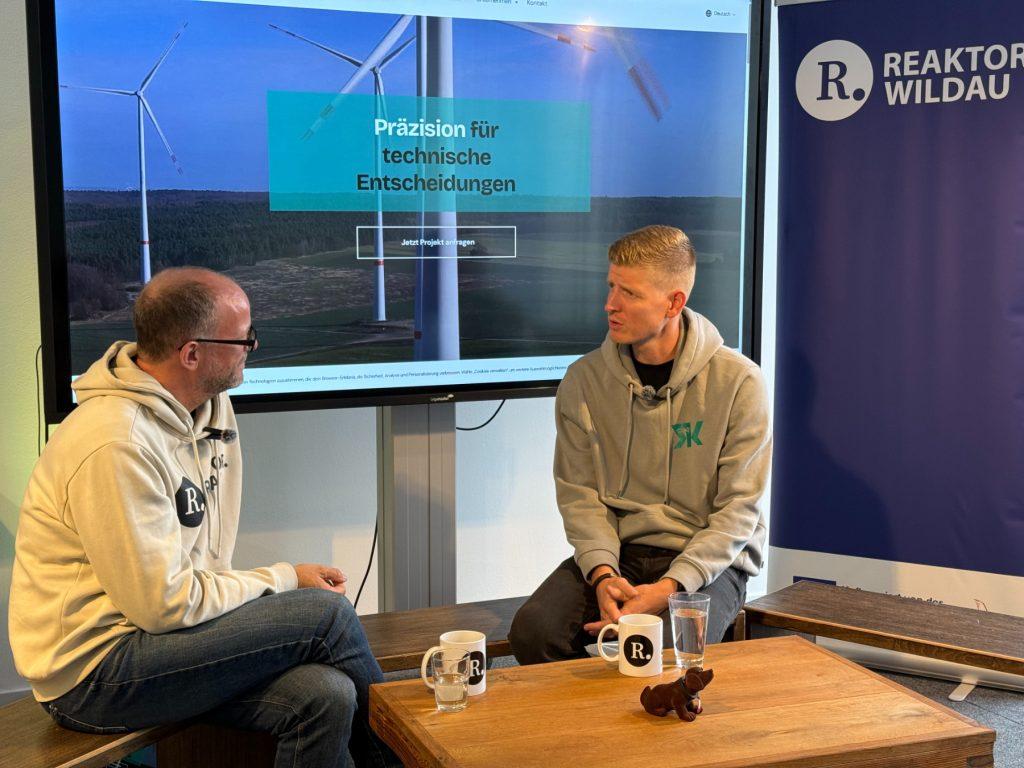
In a conversation with Rafael Kugel, Robin Krüger explains how a drone hobby turned into a scalable business idea, why families also played a role in the search for a co-founder, and why acquiring customers remains a challenge even with many years of sales experience.
His goals for the next three months are specific: five to six employees, the first long-term framework agreements, and secured bank financing. We’ll check in to see if these milestones have been reached in our next conversation with RK Droneview.
RK Droneview
What began as an independent drone service is evolving into a scalable business model: RK Droneview aims to digitally assess the condition of real estate and energy facilities, document changes, and enable operators to make better decisions regarding maintenance and upkeep. Founder Robin Krüger already has his first customers, is putting together his team, and is working on a platform that is intended for use across Europe in the future.
Which ten out of every hundred wind turbines will need attention tomorrow?
Anyone operating a hundred wind turbines should really know which ones need to be inspected or repaired most urgently. In practice, however, this question isn’t always easy to answer.
This is precisely the question Robin Krüger likes to ask potential customers: Which ten of your hundred wind turbines will need your attention tomorrow?
The answer is often a shrug, says the founder of RK Droneview. While plenty of technical operating data is available, operators often lack a systematic overview of the external condition of their turbines.
Krüger wants to change that.
His company digitizes the condition of real estate and energy facilities. To do this, it uses drones, high-resolution cameras, thermography, and other inspection methods. But the actual business idea goes far beyond simply capturing images.
RK Droneview aims to turn inspection data into actionable insights. Operators should be able to see at a glance which systems are in good working order, where anomalies need to be monitored, and where immediate action is required.
The drone is just the tool
An example illustrates the approach: A 15-centimeter-long crack is detected on the facade of a building. On its own, this does not necessarily require immediate action. However, if the next inspection reveals that the crack has grown by another 20 centimeters, the assessment changes.
What matters, therefore, is not just the snapshot at a given moment, but the documentation of how the condition evolves over time.
RK Droneview aims to capture this information over extended periods and make it comparable. This allows operators to track changes, commission repairs in a more targeted manner, and subsequently verify whether identified damage has actually been repaired.
For companies with large real estate or energy facility portfolios, this can result in significant added value.
This is because an inspection often yields hundreds or thousands of images. Evaluating these individually is time-consuming. A disorganized photo archive is of little help to an operator when they need to quickly decide which facilities require their attention.
That is why RK Droneview is developing a digital platform that displays facilities on a map, consolidates inspection results, and highlights critical issues.
A traffic-light system is designed to help prioritize the urgency of individual actions.
Currently, the company handles the entire process itself: from inspection and data analysis to the delivery of results. In the long term, customers will also be able to upload data they have collected themselves to the platform.
This could enable RK Droneview to evolve from a specialized inspection service provider into a technology-oriented platform provider.
When It’s Already Raining Through the Roof
In Krueger’s experience, the importance of early inspections is particularly evident in the real estate industry.
Some customers only contact the company once damage has already occurred. For example, when water seeps into a production hall but the cause cannot be clearly pinpointed.
By the time moisture becomes visible inside the building, damage may have been occurring for quite some time.
Through systematic inspections, RK Droneview aims to help detect such issues earlier.
The company focuses on two business sectors: the real estate industry and the energy sector.
In Krüger’s view, both markets share a key commonality: operators need reliable information about the condition of their facilities in order to plan maintenance measures in a cost-effective manner.
Twenty Years of Professional Experience and a Passion for Drones
It wasn’t part of the plan from the start that Robin Krüger would one day build a technology-oriented startup.
He began his professional career as a plant mechanic in building services engineering. Through various roles, he worked his way up to become a project manager.
While working, he completed a five-year degree in industrial engineering at the Technical University of Applied Sciences in Wildau.
He later moved into the industrial sector and worked in technical sales for a large corporation. In total, he brings nine years of experience in B2B sales to the table.
His last professional role before founding his own company already brought him into the world of startups. As Head of Sales and Contracts and an authorized signatory, he helped build various business units and shape the growth of a young company.
His enthusiasm for drones initially developed independently of this, as a hobby.
About a year ago, Krüger decided to turn this passion into a career and founded RK Droneview, initially as a sole proprietorship.
The original idea was relatively simple: to offer professional drone services while drawing on his own technical expertise.
At that time, it was not yet foreseeable that this would one day become a digital platform for assessing the condition of large infrastructure portfolios.
Reaktor Wildau Changes the Perspective
The decisive impetus for further development came from a startup consulting firm that drew Krüger’s attention to Reaktor Wildau.
Although he lives nearby and had studied at the Technical University of Applied Sciences in Wildau, he was initially barely aware of the accelerator program.
In April, he applied for the second batch, participated in Selection Day shortly thereafter, and was accepted.
The exchange with other startups, the mentors’ questions, and the intensive examination of his business model changed his perspective.
What began as a plan to generate his own income through drone inspections gradually evolved into a vision for a scalable company.
Krüger realized that his experience in building services engineering, industry, sales, and startup management provided a foundation not only for offering a service but also for developing a more comprehensive product.
This also changed the demands placed on the company.
A scalable platform business requires different structures, additional expertise, and, in the long term, a larger team.
Employee Number One—and Soon a Co-Founder
At the time of the interview, RK Droneview had just hired its first employee. For Krüger, this was a special milestone: the first official employee with employee number one. But it won’t stop there. In the coming months, the company plans to hire one more person each month.
A change is also on the horizon at the founder level. Krüger is preparing to bring on a co-founder with whom he hopes to further develop the company.
The search for a suitable co-founder unfolded differently than initially expected. At first, Krüger observed how other founding teams at Reaktor Wildau worked together and how they had found each other. Only then did it become clear to him that he didn’t want to take the next steps in the company’s development alone.
A potential contact eventually arose through his personal circle. After an initial conversation that did not lead to a partnership, another recommendation led him to the person with whom Krüger now hopes to co-found the company. This was followed by several discussions, an in-depth personal exchange, and eventually even a meeting between their families.
For Krüger, this was no minor step.
As a father of three, he knows how deeply starting a business can impact one’s personal life. Partnering with a co-founder means not only shared business responsibility but also many hours that the two will spend together in the future.
That’s why, in addition to professional expertise, the personal chemistry, willingness to take risks, and family circumstances must all be a good fit for him.
The identity of the future co-founder will be announced at a later date.
Initial Revenue Instead of Exclusively Product Development
Unlike many technology-focused startups, RK Droneview isn’t starting from scratch.
The company already offers inspection services, has acquired its first customers, and is generating revenue. These existing services form the economic foundation for further growth. While the operational inspection business is already up and running, the digital platform is still under development.
Krüger is thus pursuing a two-stage business model: First, revenue is generated through inspections. At the same time, a digital product is being developed that, in the long term, will be used independently of the company’s own data collection. Another advantage of this approach lies in direct customer contact.
With every inspection, RK Droneview learns more about operators’ requirements and can incorporate these insights into the platform’s development. This is intended to prevent the creation of a product that, while technologically interesting, fails to address customers’ actual needs.
From Pilot Project to Long-Term Framework Agreement
Currently, RK Droneview still operates primarily on a project-by-project basis. Many new customer relationships begin with pilot projects. In the medium term, Krüger aims to develop these into recurring inspection contracts, ideally with terms of up to four years.
This would have several advantages.
Recurring contracts would ensure more predictable revenue and, at the same time, make internal processes more efficient. This is because the initial assessment of a facility is particularly time-consuming. For subsequent inspections, existing data can serve as a basis for comparison.
This also benefits customers: Instead of merely documenting individual instances of damage, they could track the condition of their facilities over several years.
However, the path to securing such contracts is challenging. Large companies and corporations, in particular, have lengthy decision-making and procurement processes. Even getting listed as a new supplier can take a lot of time. Krüger is familiar with these challenges from his many years of sales experience. Nevertheless, he was surprised by just how much patience customer acquisition requires, even for experienced salespeople.
His most important insight: Startups should begin sales efforts as early as possible. After all, many months can pass between the first meeting and a signed contract.
Initial Growth Through Organic Means
When it comes to financing, RK Droneview is also taking a relatively traditional approach for now.
The company’s founding and development to date have been financed with its own funds. For the next steps, the company is working on securing bank financing to cover investments and initial personnel costs.
At the same time, revenue from the inspection business is expected to help finance the development of the digital platform.
Krüger has drawn up a growth plan for the next two years.
In the long term, however, he also considers it likely that an investor will take a stake in the company, especially if the platform is to be rolled out across Europe.
For him, this is not solely about capital. A strategic investor—for example, one with experience and contacts in the energy sector—could also be valuable to the company in terms of market access and further development. Krüger wants to begin the search for such a partner in a timely manner. Just as with selecting a co-founder, the long-term partnership must be the right fit.
Starting a Business: Between Euphoria and Patience
When asked about the biggest challenges he’s faced so far as a founder, Robin Krüger doesn’t have to think long. He hasn’t considered giving up yet. Anyone with a goal in mind must work consistently toward it. What does challenge him, however, is the constant emotional ups and downs. A successful meeting with a client can spark great euphoria. The next day, however, may bring another long process whose outcome is still completely up in the air.
This becomes particularly clear when it comes to scheduling. Many developments take longer than initially expected. Client decisions are postponed, contracts require additional coordination, and even internal processes don’t always go as planned.
For Krüger, therefore, conservative planning is one of the most important lessons he’s learned so far as a founder.
At the same time, he says, you have to stay bold and not let delays discourage you.
He therefore gives his co-founders at Reaktor some clear advice: Don’t spend too long working on your own idea without talking to potential customers. It’s better to start sales early and find out whether the market actually needs the product.
Five to six employees and first framework agreements
Robin Krüger has set specific goals for the next three months. The team is set to grow to five to six people. In addition, RK Droneview aims to secure its first one or two long-term framework agreements. Another important milestone is finalizing the ongoing bank financing.
If these steps are successful, Krüger believes the company will have a significantly more stable foundation on which to focus more strongly on the platform’s further development and growth.
However, the company’s sights are already set further ahead. While RK Droneview currently operates primarily in the DACH region, Krüger sees great long-term potential, particularly in the European energy sector. The vision is a platform that provides operators of large asset portfolios with a structured overview of the technical condition of their infrastructure—regardless of who collected the underlying inspection data. There is still a long way to go. The platform is under development, the organization is growing, and the business model is being refined in collaboration with customers. Yet what began as a hobby involving drones has, in a short time, evolved into a company with initial revenue, new employees, and ambitious growth plans.
Whether RK Droneview will make the next leap from inspection service provider to a scalable platform company remains to be seen in the coming months.
Startbase will continue to follow the company’s progress as part of its series on the startups from the second Reaktor batch. The next interview will focus, among other things, on how far the team has grown, whether the first framework agreements have been signed, and what progress the digital platform has made.
“The drone is just the tool”—how RK Droneview is digitizing the inspection of buildings and energy facilities—The Interview
Robin Krüger originally founded RK Droneview as a sole proprietorship. Today, he is developing it into a scalable business model for the digital condition assessment of real estate and energy infrastructure. In a conversation with Rafael Kugel from Reaktor Wildau, he explains how his business idea has evolved, why he’s bringing a co-founder into the company, and what goals he’s set for the coming months.
Rafael Kugel: Robin, what exactly does RK Droneview do?
Robin Krüger: We digitize the condition of energy facilities and real estate. We do this primarily from the air, using drones. This is a major advantage, especially for facilities that are hard to access or difficult to inspect.
We collect the data, analyze it, and make it available to our customers in a way that allows them to make informed decisions. Our goal is to ensure that operators don’t have to wait until damage has occurred to react. They should be able to identify anomalies in advance and determine where they may need to take action.
Rafael Kugel: So, over time, data is collected that can also be used to determine whether damage is getting worse?
Robin Krüger: Exactly. Let’s take a simple example: A large building has a crack in the facade, perhaps 15 centimeters long. The operator is aware of it and decides to take another look at it next year. But if the crack has grown by 20 centimeters by then, the situation looks quite different.
We can document these changes and track them over time. In the same way, we can verify whether a commissioned repair was actually carried out and whether the original damage has been fixed.
Rafael Kugel: So your actual product isn’t the drone flight itself, but rather the digital visualization and assessment of the infrastructure?
Robin Krüger: Exactly. Our target customers are companies with large asset portfolios. I like to ask potential customers a question: If you operate 100 wind turbines, which ten of them will need your attention tomorrow?
They often just shrug at first. Operators frequently don’t have a complete overview of the external condition of their turbines.
The drone is just the tool. We also work with thermography, handheld cameras, and other methods. What matters most is what happens to the data afterward. We want to process it so that the customer can see at a glance where action is needed.
You can think of it like a traffic light system: Where is everything okay? Where should we take a closer look? And where is the situation critical and does a company need to be hired?
Rafael Kugel: What does the product actually look like? Is it a dashboard that displays the systems?
Robin Krüger: Exactly. During an inspection, a large number of images are captured—both regular photos and thermal images. If I simply hand the customer a big photo album, it’s not very helpful to them.
That’s why we create reports tailored to each specific use case—for example, for insurance claims. In addition, there’s a dashboard with a map where customers can see an overview of their facilities. They can select individual facilities and identify any anomalies that were detected.
The critical points are highlighted. The operator shouldn’t have to search for a long time but should be able to quickly identify where action is needed.
Rafael Kugel: So you offer both data collection and analysis. Everything from a single source?
Robin Krüger: Currently, yes. We conduct the inspections, analyze the data, and provide the results.
In the long term, we’d like to separate these two areas. Then customers will have the option to upload their own data to our platform and analyze it there.
But we’re a young company. Right now, it’s important to learn alongside our customers and understand their requirements precisely. If we manage the entire process ourselves, we can also better control the quality.
Rafael Kugel: Especially with wind turbines or large buildings, misjudging damage can have serious consequences.
Robin Krüger: Absolutely. With buildings, for example, we often find that customers don’t reach out until damage has already occurred. By then, rain is already pouring into a production hall, and no one knows exactly where the water is coming from.
That’s exactly what we want to avoid. It can take years for water to seep in at the top and become visible at the bottom. By that time, significant damage may already have occurred.
From a Drone Hobby to a Startup
Rafael Kugel: What’s your professional background, actually? How did you come to found RK Droneview?
Robin Krüger: I founded the company about a year ago, originally with a completely different idea. Drones were a hobby of mine, and I wanted to explore that further.
I have about 20 years of technical work experience. I originally came from the building services engineering field. I started out as a plant mechanic on construction sites and worked my way up through various positions to become a project manager.
At some point, I wanted to take another step forward, so I studied industrial engineering at the Technical University of Applied Sciences in Wildau while working full-time. I completed my degree after five years.
At the same time, I made the switch to the private sector and worked in technical sales for a large corporation. My last professional role was at a startup itself. There, I served as Head of Sales and Contracts and as an authorized signatory.
I helped build up various departments and experienced firsthand how a company grows. I found that incredibly exciting. And at some point, I said to myself: Now I want to do this for myself.
Rafael Kugel: So you’d already gained startup experience without being the founder yourself. You then started out as a sole proprietor offering drone services. Today, that’s evolved into a scalable software business. How did that come about?
Robin Krüger: It actually happened pretty quickly. I was at a startup consulting firm, and they recommended that I check out Reaktor Wildau.
To be honest, at first I didn’t really know exactly what Reaktor was, even though I live nearby.
I applied in April. The Selection Day was shortly after that, and I was lucky enough to be accepted.
And that’s when the journey really began.
Reaktor completely changed my perspective. Through the feedback, the questions that were asked, and the discussions with the other startups, I realized that my original idea could lead to so much more.
I also looked back on my own professional career and realized just how much experience I’ve actually gained. Now I can put that experience to use in a very focused way.
An incredible amount has happened since I joined Reaktor. That shows me just how much potential it holds.
The First Employee and a New Co-Founder
Rafael Kugel: You built everything up on your own at first. What’s the situation with your team? Do you want to continue working alone or bring in more people?
Robin Krüger: This is a very exciting development right now. My first employee started five days ago. My first official employee, with employee number one. That was a really special experience.
And that’s how things are set to continue over the next few months. We plan to hire one more employee every month.
There will also be some changes in management. We’re in the final stages of bringing a co-founder on board. We then want to continue developing RK Droneview together and, above all, drive scaling forward.
Rafael Kugel: How do you find the right co-founder? Especially if you’ve built the company on your own so far, that’s not exactly an easy decision.
Robin Krüger: That was actually a learning process for me. Here at Reaktor, I’ve seen how differently other startups approach this. Some founders already knew each other beforehand; others specifically sought out a co-founder.
For me, I first had to shift my perspective. I had to reach the point where I said to myself: I don’t want to do this alone anymore. I realized that I wouldn’t be able to take the next steps on my own.
So I started by looking within my immediate circle.
We had plans as a family to meet up with a couple who are friends of ours. That evening, I was lying in bed and suddenly thought: “She’s a developer, isn’t she? I just have to talk to her.”
So that’s what we did. Although it didn’t lead to a collaboration, that conversation opened another door.
Through another contact, I eventually met the person I’d now like to work with.
We started with an online conversation, hit it off right away, and then exchanged ideas more in-depth during subsequent conversations. Eventually, our families even met and spent several days together.
After that, it was clear to us that we wanted to pursue this path together.
I wasn’t desperately searching. It developed step by step, and so far it feels very right.
Rafael Kugel: Why was it so important to you that the families get to know each other, too?
Robin Krüger: You always joked with me at the beginning that my private life was over now.
But of course, there’s some truth to that. You don’t just start a company on the side. It takes an incredible amount of time.
I’m a father of three. My wife is part of the family, and everyone has to play their part.
I’ll be spending a lot of time with my future co-CEO. Of course, that also affects family life. That’s why it was important to us that we get to know each other not just professionally, but personally as well.
You need a certain amount of support. And it has to be a good fit on all sides.
Rafael Kugel: So you weren’t just looking for professional expertise, but also whether your personal attitudes and willingness to take risks were a good fit?
Robin Krüger: Definitely. I’d also spoken with other people with whom I could easily imagine working well professionally.
But at some point, you realize that it’s not just about competence. You also need a certain willingness to take risks. If that’s not there, you can’t just make it happen.
After all, we’re talking about a company we want to build together. That also involves financial responsibility and pressure that you have to be able to handle.
First Revenue and the Path to the Platform
Rafael Kugel: How far along are you with your product? Do you already have customers and revenue, or are you still in the development phase?
Robin Krüger: The inspection service is up and running. We’re already offering it; we have customers and are generating revenue.
We serve two segments: the real estate industry and the energy sector. I’ve worked in both of these fields before. Thanks to my nine years in B2B sales, I have good access to those markets.
What we’re currently building is the product behind the inspection—that is, the platform for the structured analysis and visualization of the data.
Currently, we’re still focusing on the DACH region. In the long term, we want to scale this platform across Europe. We see significant potential in the energy sector in particular.
For now, the inspection services are our solid core business. That’s how we make money and can self-fund part of our ongoing product development.
Rafael Kugel: That’s certainly an interesting model: You’re already making money from the service and, building on that, developing your actual scalable product. How are you financing this growth?
Robin Krüger: So far, we’ve financed everything ourselves.
Now we’re securing support from a bank. We plan to use this to finance our first major investments as well as our initial personnel costs.
We have an ambitious growth plan for the next two years. Our goal is to generate profits that we can then reinvest in development.
In the long term, however, we’ll likely need an investor to scale the platform across Europe.
I think we’ll be focusing more intensively on this issue next year. From my experience, I know that you can’t find the right investor in just a few weeks.
Rafael Kugel: An investor is, after all, similar to a co-founder. You’re connected to each other over the long term. So it has to be a good fit for both sides.
Robin Krüger: Exactly. It’s important to me that an investor doesn’t just bring money to the table.
Ideally, they should also be a strategic fit for us. For example, if someone comes from the energy sector and brings experience and contacts from that field, that can provide significant added value for us.
You have to get to know each other and figure out whether the collaboration will work in the long term.
Rafael Kugel: How do you expect your customer business to develop over the next twelve months?
Robin Krüger: Right now, we’re getting started with many clients through pilot projects. We’re still heavily focused on project-based work.
In the medium term, we’d like to turn these into recurring inspection contracts and framework agreements, ideally with terms of up to four years.
This provides us with predictable revenue and enables us to further optimize our processes.
The first inspection of a facility is usually the most time-consuming for us. Once the data is available, we can work more efficiently on follow-up inspections.
At the same time, we can involve customers in the platform’s further development. After all, we don’t want to develop something that nobody needs in the end.
The Challenges of Everyday Life as a Founder
Rafael Kugel: When you look back on your time as a founder so far, what were the biggest challenges? Were there moments when you thought about giving up?
Robin Krüger: No, I actually never reached that point. When I have a goal in mind, I get started and don’t stop.
But what’s really demanding is this constant emotional roller coaster.
You have a great meeting with a client, walk out feeling really good, and think: Now things are moving forward.
And the next day, you’re sitting there again, wondering what to do next. A lot of things just take much longer than you originally think.
That’s why one of my most important lessons is to set more conservative timelines. Almost everything gets pushed back. You have to factor that into your financial plan, too.
At the same time, though, you can’t lose heart.
Even with a lot of sales experience, it’s not easy to win over customers. Especially with large corporations, just getting accepted as a supplier can be a huge process in itself.
You have to build trust, agree on pilot projects, and follow up again and again.
I also tell other startups here at Reaktor: Start doing sales! You already have something to offer, so get out there with it.
Because it can take a very long time before a customer actually makes a decision and signs a contract.
What we aim to achieve in three months
Rafael Kugel: We want to continue supporting you and RK Droneview during the accelerator program and meet again in two or three months. How would you know then that this time was successful?
Robin Krüger: My goal is for us to have five—or maybe even six—people on the team in three months.
I’d also like us to have signed our first one or two framework agreements. That would be an important step toward moving from one-off project work to a more predictable collaboration with our customers.
And, of course, our current bank financing should be finalized.
Once these things are in place, we’ll be able to focus more on our actual work and the company’s continued growth.
The plan for the coming year is already largely in place. We want to gain an even better understanding of the market and then take the next steps toward scaling up.
Rafael Kugel: Robin, thank you very much for the interview. I’m curious to see how RK Droneview continues to develop and look forward to our next interview.
Robin Krüger: Thank you very much as well. I’m curious myself to see what I’ll be able to report then.


Newsletter
Startups, stories and stats from the German startup ecosystem straight to your inbox. Subscribe with 2 clicks. Noice.
LinkedIn ConnectFYI: English edition available
Hello my friend, have you been stranded on the German edition of Startbase? At least your browser tells us, that you do not speak German - so maybe you would like to switch to the English edition instead?
FYI: Deutsche Edition verfügbar
Hallo mein Freund, du befindest dich auf der Englischen Edition der Startbase und laut deinem Browser sprichst du eigentlich auch Deutsch. Magst du die Sprache wechseln?