Public Makers: Not Just Understanding the Public Sector, but Helping to Shape It

Anyone studying today who wants to make a difference quickly thinks of startups, tech companies, or consulting. That’s where the opportunity seems to lie to put new ideas into practice, take on responsibility, and build things from the ground up.
The public sector, on the other hand, is often perceived differently: as large, complex, and slow—and, above all, as something that already exists and needs to be managed.
In our view, this very distinction is the problem.
Some of the most important challenges of our time lie in the very places where the government and society are organized: in municipalities, government agencies, and public institutions. Digitalization, artificial intelligence, mobility, education, and new forms of civic engagement are not abstract topics. They have a very concrete impact on how we will live together in the future.
The question, therefore, is not only how the government can become more innovative.
But also who shapes it .
Who are Public Makers?
We call the people who take on this responsibility “Public Makers.” For us, “Public Maker” is neither a job title nor a specific career path.
You can work in government and be a Public Maker. You can start a startup and be a Public Maker. You can study, develop, conduct research, or teach and be a Public Maker.
What matters is the mindset behind it.
A Public Maker doesn’t just wait for change to come from somewhere else. He or she asks: What can I personally contribute? What’s worth changing? And how can we turn an idea into something that actually works?
This is precisely where two ways of thinking—which are often viewed separately—converge for us.
The public sector needs continuity, institutional knowledge, and the ability to think long-term. Founders, on the other hand, often bring something different to the table: the drive to get started before every question has been definitively answered, to try things out, and to learn from the results.
We believe we’ll need both in the years ahead.
People who can get started without losing sight of the long-term consequences. And people who understand existing institutions without believing that everything has to stay exactly as it is.
We see this combination as part of public entrepreneurship.
From Talk to Action
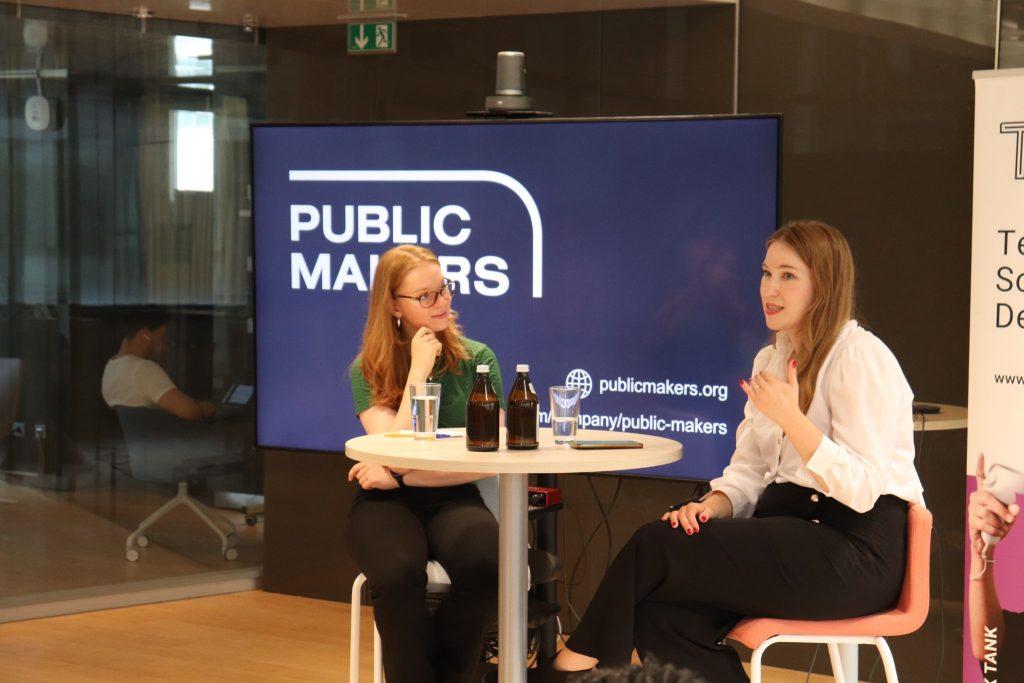
Public Makers is therefore meant to be more than just an idea.
Our work is all about giving young people the opportunity to get to know the public sector, to connect with people in this field, and, above all, to gain hands-on experience in shaping it themselves.
You can talk at length about how innovation should work in the public sector. But actually being confronted with such challenges for the first time is something else entirely.
When a team has to understand why a process works the way it does today. When students talk to the people who work on a problem every day. When an initial idea turns into a prototype. And when that prototype suddenly isn’t just a presentation for a seminar anymore, but something that can actually be tested.
That is exactly why formats in which people can develop and experiment on their own are a central part of our work.
We bring young talent together with people and organizations from the public sector, foster dialogue, and create spaces where public challenges can give rise to concrete solutions.
Our goal isn’t necessarily to pair every problem with a startup.
We’re initially interested in something more fundamental: How can we get more people to take responsibility for a problem and start working on it?
What Public Entrepreneurship Has to Do with Startups
It is precisely here that we see a strong connection to the startup world.
For us, entrepreneurship doesn’t begin with founding a company. It starts earlier.
Someone identifies a problem. Tries to understand who this problem affects. Develops an initial idea. Tests it. Discards parts of it. Talks to users. Keeps building.
Whether this later becomes a startup, a project within a government agency, or a completely different form of implementation is secondary at first.
The approach is the same: don’t get stuck on the problem, but take the next step.
One example of this is the START Public Makers Lab, where students work on real-world challenges from the public sector.
The idea behind it is deliberately different from a traditional case study. Participants aren’t just supposed to analyze what could theoretically be done. Together with partners, they’re supposed to understand what the actual problem is, develop potential solutions, and build something from that that can be tested.
For students, this changes their perspective on the public sector.
Suddenly, a government agency is no longer just an abstract institution. It becomes a place with users, processes, technical challenges, and problems for which new solutions can be developed.
And for public partners, this simultaneously creates the opportunity to collaborate with people who bring new perspectives and different ways of working to the table.
It is precisely at this intersection that entrepreneurial thinking becomes social innovation.
Not everyone has to start a business, but everyone can shape society
We don’t aim to turn every student into a founder.
Perhaps a project will eventually evolve into a GovTech startup. Perhaps someone will then decide to pursue a career in the public sector. Perhaps someone will bring a particular way of working into an existing institution and effect change there.
All of these paths are relevant.
After all, the challenges facing the public sector won’t be solved simply by the availability of new technology.
Artificial intelligence can also speed up processes, analyze information, or take on repetitive tasks. But it doesn’t decide for us which social issues are particularly important, which changes make sense, or what responsibilities we want to take on in the process.
That requires people with sound judgment—and people who are willing to translate that judgment into action.
A community of people who are taking the first steps
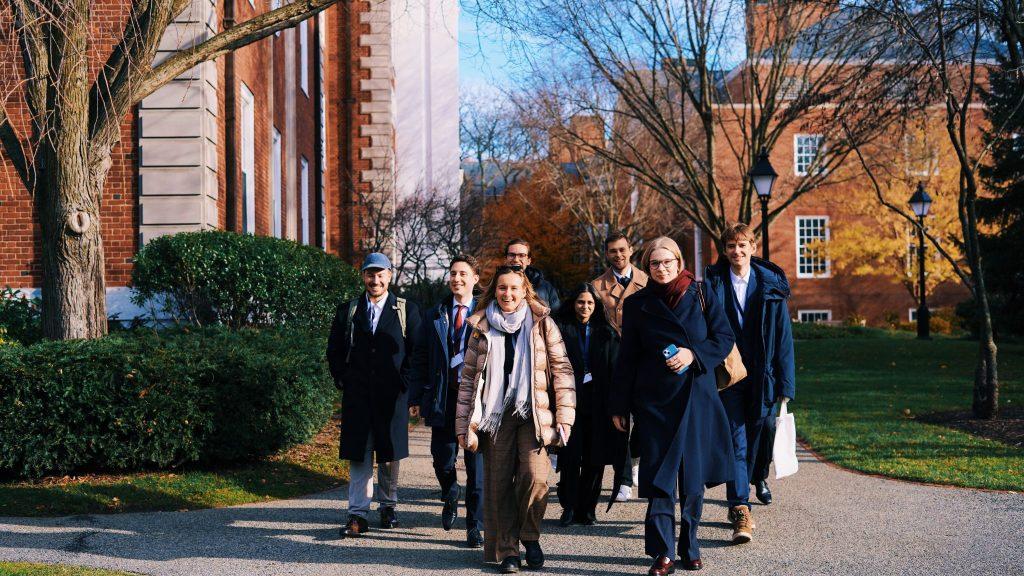
In the long term, we therefore want to achieve more with Public Makers than just individual projects or events.
We want to connect people who share a similar mindset, regardless of whether they work within or outside public institutions.
After all, taking on existing structures alone can be frustrating. When people with similar ambitions find one another, share experiences, and work together, something else emerges: a community that shows that change is possible.
Perhaps, in the end, that is the most important idea behind Public Makers.
The public sector is not something shaped exclusively by “the government.”
It is an essential part of our shared lives and, as such, something for whose future we can take joint responsibility.
We’re not waiting for the culture to change on its own someday.
We want to bring together the people who are already starting to change it today.




Newsletter
Startups, stories and stats from the German startup ecosystem straight to your inbox. Subscribe with 2 clicks. Noice.
LinkedIn ConnectFYI: English edition available
Hello my friend, have you been stranded on the German edition of Startbase? At least your browser tells us, that you do not speak German - so maybe you would like to switch to the English edition instead?
FYI: Deutsche Edition verfügbar
Hallo mein Freund, du befindest dich auf der Englischen Edition der Startbase und laut deinem Browser sprichst du eigentlich auch Deutsch. Magst du die Sprache wechseln?