When a Click Comes from a Bot: How PYURE Aims to Make the Digital Advertising Industry More Transparent

Startbase supports startups from Reaktor Wildau – today: PYURE
In our exclusive series on the startups from the second batch of Reaktor Wildau, we feature one of the 14 participating companies every Saturday. We follow their progress throughout the accelerator program and document how innovative ideas evolve into marketable products and successful business models.
Following our previous profiles on Boomerent, Movolta, and RK Droneview, today we feature PYURE is in the spotlight. The startup is developing technology that enables companies to analyze their digital advertising campaigns, detect ad fraud, and use their marketing budgets more efficiently. At the same time, PYURE makes it possible to measure the energy consumption and CO₂ emissions of digital advertising.
The idea arose from a question that was initially quite different: Just how sustainable is digital advertising, really? Founder François Roloff, who has been working in the digital advertising industry for over 20 years, began exploring this question as early as 2023. PYURE was founded in early 2024. The company now employs eight people, serves nearly 30 clients, and has offices in Berlin, Düsseldorf, and at Reaktor Wildau.
But along the way, the company’s positioning has shifted. While environmental sustainability was the primary focus at the start, the main goal today is to offer companies an immediately measurable economic benefit. This is because a significant portion of digital advertising budgets can be lost due to inefficient ad delivery, automated clicks, or fraudulent activities. PYURE aims to highlight these vulnerabilities and help advertisers achieve greater impact with their existing budgets.
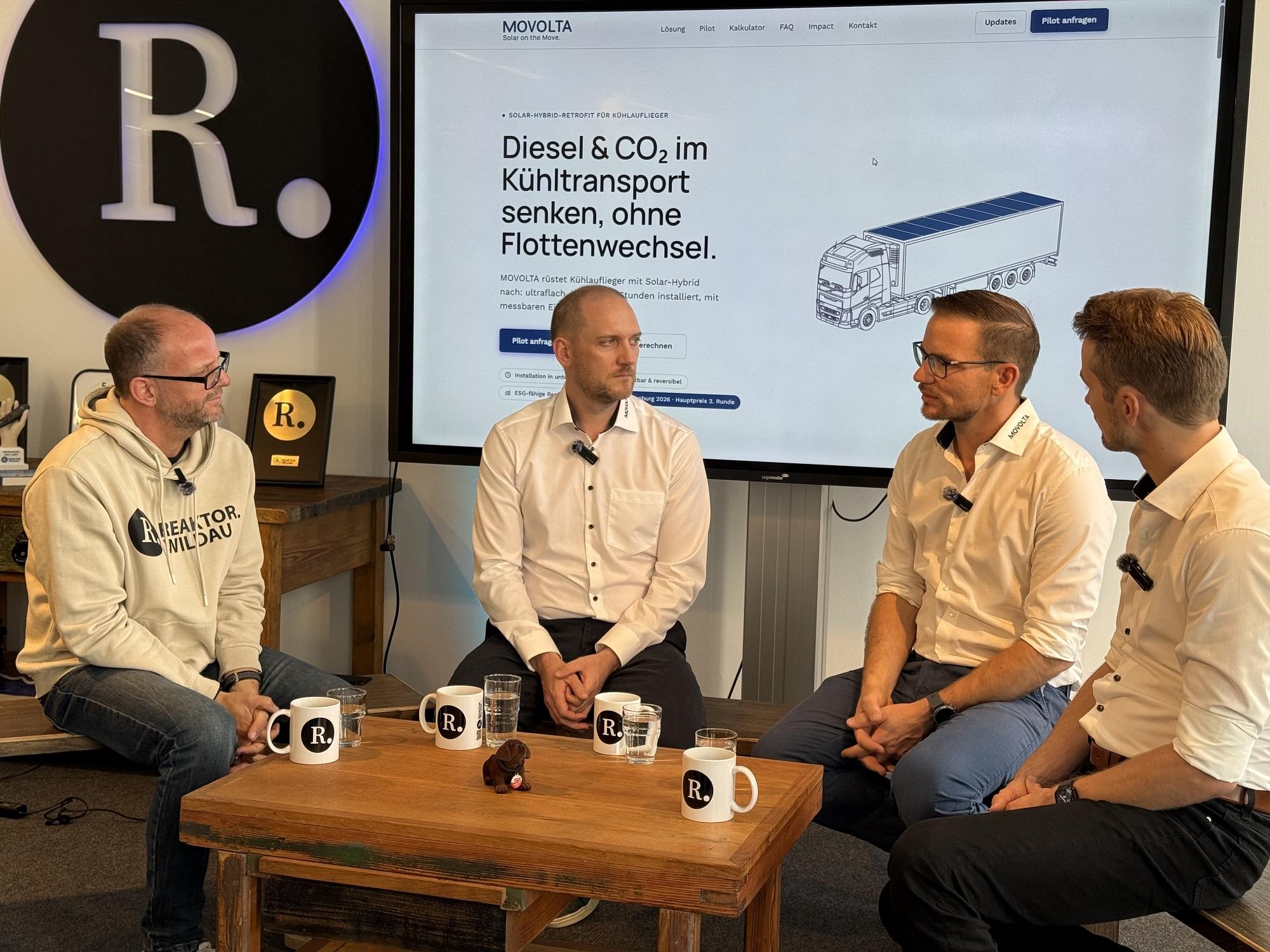
In a conversation with Rafael Kugel, Managing Director of Reaktor Wildau, François Roloff explains how a sustainability idea evolved into a business model for optimizing digital advertising, what role artificial intelligence plays in this, and why the startup has not, despite everything, abandoned its original mission. The conversation also covers the challenges of founding the company, its first clients, its proprietary technology platform, and the next steps toward international expansion.
When Advertising Falls on Deaf Ears
Anyone who runs online ads wants to reach people. But what happens when there’s no human behind a supposed click—only an automated program? Or when companies pay for ad space that barely makes an impact?
This is exactly where PYURE comes in. The platform analyzes digital advertising campaigns, identifies suspicious activity, and reveals where advertising budgets are being wasted. In doing so, the startup looks not only at traditional metrics like clicks and reach but also at technical processes and their energy consumption.
Founder François Roloff sums up the idea with an unusual comparison: “We’ve become the Federal Audit Office for the advertising industry.”
The goal is simple: Every euro invested in advertising should have the greatest possible impact—while consuming as few resources as possible.
PYURE
Companies invest substantial sums in digital advertising. But not every click comes from a human, and not every euro invested achieves the desired effect. The startup PYURE analyzes where advertising money is being wasted and is developing a platform designed to make marketing campaigns more efficient—both economically and ecologically.
A click after just 0.13 seconds. For François Roloff, this is a pretty clear indication that a human may not have responded to an ad here. After all, even a particularly attentive user would likely have difficulty even noticing an ad in that amount of time, let alone clicking on it. It’s more likely that an automated program is behind it.
Such bots are no longer a marginal phenomenon in the digital advertising industry. They can simulate clicks and other interactions, thereby ensuring that companies pay for supposed ad impressions that never actually took place. Added to this are other manipulation techniques, such as so-called SDK spoofing, in which technical signals from mobile applications are faked to simulate advertising activity or app installations.
This is a problem for companies that run digital ads. They invest money to reach potential customers but often find it difficult to track which portion of their budget actually achieves the desired effect. This is because numerous technical platforms and automated processes now stand between the advertiser and the user.
This is exactly where PYURE comes in. The software analyzes the technical data behind advertising campaigns and looks for anomalies that indicate inefficient ad delivery or fraudulent activity. If the system detects suspicious IP addresses, for example, these can be excluded from future ad deliveries. The goal is to reduce unnecessary spending and ensure that as much of the allocated budget as possible goes where it can actually make an impact.
PYURE doesn’t limit itself to searching for bots. The company also examines how efficient the technical processes behind a campaign are and where unnecessary resource consumption can be avoided. After all, every digital ad requires infrastructure: data centers, networks, and end devices consume energy while the ad is being delivered. The more complex the processes, the greater the associated resource consumption can be.
From Media Plan to Optimization
The company’s new technology platform demonstrates how this works in practice. Companies can upload their planned advertising campaigns there, for example as a PDF or CSV file. PYURE analyzes these media plans and, within a maximum of 24 hours, generates a forecast of potential emissions and identifies areas where the campaign can be improved.
The next step is particularly interesting. The platform is not intended to simply spit out numbers, but to provide concrete recommendations. Which ad placements make sense? Where are there signs of unnecessary costs? What changes could reduce energy consumption without compromising the advertising impact?
Marketing managers can implement these recommendations themselves. In the future, however, PYURE also plans to transfer the results directly to the systems companies use to purchase their ad space. The optimization could then be largely automated.
For François Roloff and his team, the first full demonstration of their platform was a special moment. They had spent a long time working on individual features, algorithms, and technical interfaces. Now, for the first time, the various components were visible in an integrated application. An idea that had long existed primarily in presentations and development concepts had become a truly usable product.
It had been a long road to get there, however. Like many tech startups, PYURE faced the challenge of developing a complex product while simultaneously acquiring its first customers. Spending several years working exclusively on its own software without generating revenue was not a realistic option. That’s why, when entering the market, the company initially relied on third-party technologies. This allowed the team to implement its first client projects and gain experience while continuing to develop its own platform.
According to the founder, PYURE now has just under 30 paying customers. These include both companies that run their own ads and operators of digital advertising platforms. In an interview, François Roloff mentions, among others, Lufthansa, Kleinanzeigen, and companies in the financial sector.
The interests of these two customer groups differ significantly. While advertisers want to get the most impact possible out of their budget, operators of advertising platforms must be able to prove that the ad spaces they offer actually meet the promised quality standards. An independent analysis can therefore be beneficial for both sides.
Why Sustainability Remains Important
Measuring the environmental footprint of digital advertising remains a key component of the technology. In doing so, PYURE goes beyond simple estimation methods, such as multiplying an advertising budget by a flat-rate emission factor.
While such calculations can provide an initial guide, they take only limited account of how a campaign was actually executed. PYURE therefore aims to evaluate activity data as concretely as possible and use it to determine energy consumption and the associated emissions.
This is particularly relevant for larger companies that are required to document their sustainability efforts and prepare corresponding reports. However, in the interview, Roloff highlights an important distinction: A projection of potential savings does not constitute proof that those savings were actually achieved. To demonstrate this, data from campaigns that were actually carried out is required.
Economic and environmental considerations are thus intertwined. Avoiding unnecessary technical processes or reducing advertising contacts that offer no actual benefit can save both money and energy. It is precisely this connection that is of interest to PYURE. It enables the company to reach out even to businesses for which sustainability is not currently at the top of their priority list.
Eight employees, just under 30 clients, and plenty of development work ahead
With eight employees, PYURE remains a relatively small company. A significant portion of the work involves software development, algorithms, and artificial intelligence. At the same time, the company must acquire new clients, manage existing projects, and integrate additional features into the platform.
The fact that the technology is already in use does not mean that the company is yet financially self-sufficient. PYURE continues to be supported by investors. The founding team expects to reach the break-even point by 2028 at the latest.
Until then, the main priority is to increase the number of customers and scale its own technology as efficiently as possible. This is because with every new customer, not only does revenue grow, but so does—at first—the effort required for integration, support, and further development.
An important step, therefore, is to consolidate as many functions as possible into a single platform. So far, PYURE has focused primarily on paid media—that is, paid digital advertising. With the acquisition of a small Berlin-based startup, the company has since expanded its offerings to include content marketing and organic social media activities.
In the future, traditional forms of advertising such as print and outdoor advertising are also set to be added. Technically, however, this is more challenging than it initially sounds. While digital platforms automatically generate large amounts of data, information about analog advertising campaigns often first needs to be collected and converted into a comparable format.
For PYURE, therefore, it’s not just about developing new features, but about integrating different data sources in a way that actually yields actionable results.
AI Agents and a Look Abroad
Artificial intelligence is also set to play a greater role in the future. PYURE is working to make its technology accessible to AI agents via interfaces. These agents could automatically transfer data from advertising platforms to the analytics platform and then use the results directly to optimize campaigns.
This would significantly change current workflows. Instead of marketing managers regularly evaluating reports and manually deriving actions from them, individual steps could be automated in the future. However, this requires that the participating advertising platforms provide the necessary data and allow for technical integration.
At the same time, PYURE is planning to expand into international markets. Starting in 2027, the company aims to increasingly acquire customers outside the German-speaking region. François Roloff considers France and the United Kingdom to be particularly promising markets. He notes that the concept of sustainable advertising technology is already more firmly established within the industry there than in Germany.
For a company like PYURE, international expansion could represent a significant growth opportunity. After all, the challenges the startup is addressing do not stop at national borders. Digital advertising campaigns are often run internationally, and the technical platforms behind them are the same across many markets.
First, however, PYURE must demonstrate that its technology can be operated profitably on a larger scale. The platform has been developed, the first customers have been acquired, and additional features are in the works. The challenge now is to turn this into a sustainably viable business.
For François Roloff, the fact that this path isn’t always straightforward is simply part of the startup experience. In this interview, he speaks openly about client projects that weren’t pursued despite successful testing, and about the difficulty of winning over new clients in economically uncertain times.
At the same time, the company’s development so far shows how important it is for a startup to adapt its offerings to the actual needs of the market. PYURE started with a sustainability concept and developed it into a business model that prioritizes economic efficiency. The original objective hasn’t disappeared, but has remained part of the solution.
Whether this will result in an internationally successful company remains to be seen. With its own technology platform and its first customers, PYURE has certainly laid the groundwork for this.
“We get more out of every euro spent on advertising”—an interview with PYURE founder François Roloff
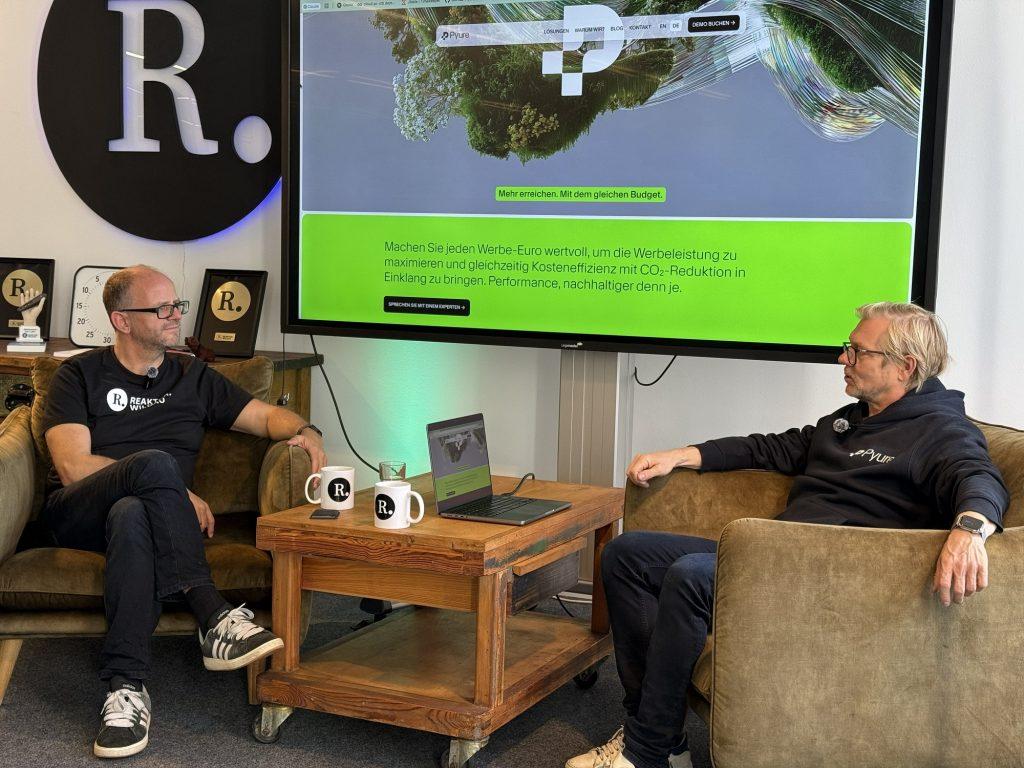
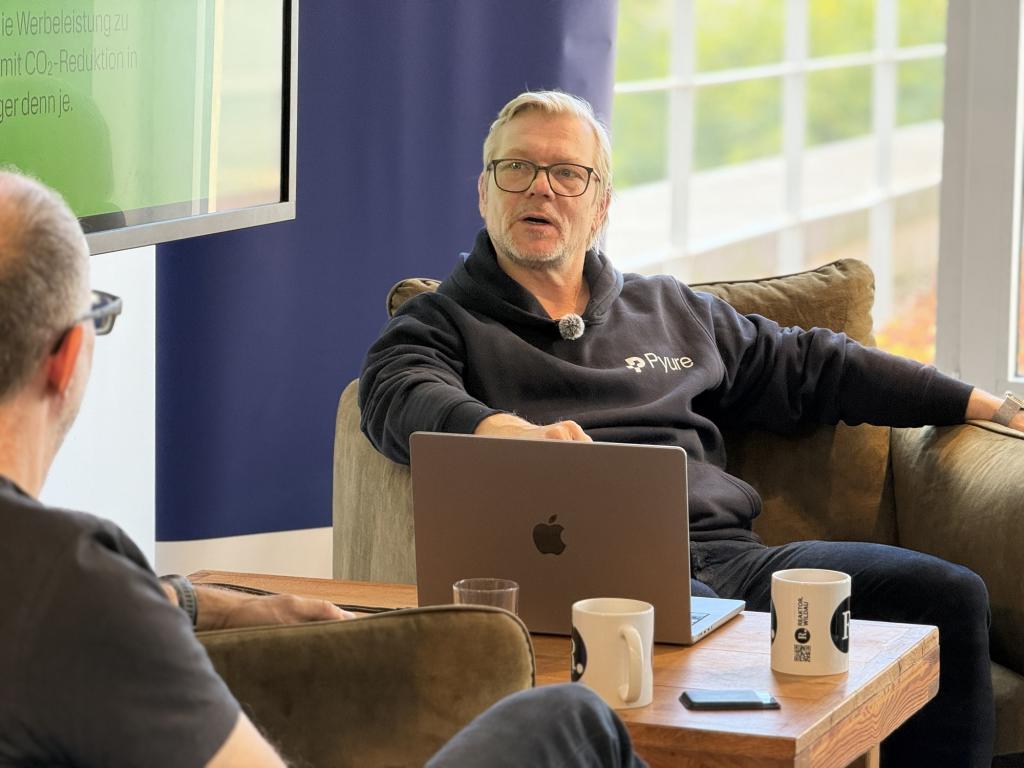
How can digital ad fraud be detected, how can companies use their marketing budgets more efficiently, and what role does sustainability play in this? PYURE founder François Roloff speaks with Rafael Kugel, managing director of Reaktor Wildau, about the development of his startup, the challenges of building his own technology platform, and the next steps for growth.
Rafael Kugel: François, it’s great to have you here. Tell us: What exactly does PYURE do?
François Roloff: We entered the market about two and a half years ago with the goal of advancing sustainability in digital advertising. But we all know how much pressure this issue is under right now. That’s why we decided to focus not only on energy efficiency, but above all on budget efficiency and budget maximization in marketing.
So the short answer to the question of what PYURE does is: We get more out of your marketing budget—the advertising budget you’ve set for yourself and earned the hard way. We make sure that every euro goes exactly where it’s supposed to and is invested in the ad spaces and marketing initiatives you had in mind.
Rafael Kugel: That sounds exciting. On the one hand, you’re saving energy, which can also save costs. But how does that work in practice?
François Roloff: As a startup, you’re always looking for a metaphor that makes it easy to explain your business model. The metaphor I like to use right now is: We’ve become the Federal Audit Office for the advertising industry.
We all know what the Federal Audit Office does. In principle, we do something similar. We disclose where the allocated budget is being spent—or is supposed to be spent—and whether it’s actually achieving its maximum impact there.
Every marketing euro that Reaktor invests, for example, is ultimately hard-earned money. A lot of work goes into it, and of course, it has to pay off. If only half—or even less—of that advertising euro ends up where you actually planned it to go, there’s significant room for improvement.
That’s exactly what we uncover. We’ve developed a technology that monitors your marketing in real time, identifies weak spots, and reveals where budget is being wasted unnecessarily.
Rafael Kugel: What kind of weakness might that be, for example?
François Roloff: Let’s say you want to run ads on news sites, online platforms, or in a sports context. Unfortunately, some of these environments are plagued by so-called bots. These are automated programs that trick you into thinking they’re human.
Your ad may not have actually reached a human at all, but rather a bot that clicked on it.
We can identify such anomalies, among other things, by looking at the time interval between when an ad fully loads and the subsequent click. If only 0.13 seconds elapse, you can be fairly certain that it wasn’t a normal human user. In some cases, the entire page might not even have finished loading by that point.
Rafael Kugel: With a reaction time like that, it’s either the world champion in gaming or a bot.
François Roloff: Exactly. And the world champion in gaming doesn’t tend to visit these sites very often.
Another example is app marketing. Imagine you’ve developed an app and want to make it more well-known. So you invest money to make it more visible in the App Store and get more people to download it.
There are manipulation techniques here, such as what’s known as SDK spoofing. This involves faking technical activity or users. As a result, your ad budget may be spent, but the desired results may not be attributed to your campaign at all—or may be attributed incorrectly.
Rafael Kugel: Let’s stick with the example of bots. I place an ad for Reaktor on some website. You detect that a bot is clicking on it. What happens then? Can you prevent my ad from continuing to be displayed there?
François Roloff: Exactly. That’s one of the areas we focus on. For example, we can identify IP addresses or entire IP address ranges where such suspicious activity occurs. These can then be blocked.
So once a bot has been detected, we can prevent the same ad from being served again to that address, which has been classified as non-human.
Rafael Kugel: So, once the bot clicks on it, you’ve identified it, and the second time around, it no longer sees the ad?
François Roloff: Exactly.
Rafael Kugel: I think I’ve got a pretty good grasp of what you do now. How far along are you at this point? Is the product finished, are you on the market, do you already have customers?
François Roloff: You’re never really “done” with a product like this. New technologies and techniques are constantly emerging that attempt to fraudulently make money through digital advertising. It’s a bit like dealing with hackers. You develop protective mechanisms, and on the other hand, new methods keep popping up.
We’ve made eco-efficiency our focus. For us, that means both economic and ecological efficiency. Originally, we developed our technology to uncover ecological inefficiencies and unnecessarily high electricity consumption in these complex digital process chains.
We’re still doing that. But now we’re also taking a very close look at the economic implications.
Our platform works—it identifies inefficiencies and helps companies make better use of their budgets. And we already have paying customers.
Rafael Kugel: How many are there now?
François Roloff: We currently have just under 30 clients. We generally distinguish between two groups.
On the one hand, there are the advertisers—that is, companies that place ads. These include well-known brands such as Lufthansa, Kleinanzeigen, and companies in the banking sector.
On the other hand, there are the so-called media owners. These are operators of websites, digital media, or advertising platforms that offer ad space themselves.
Our technology is also of interest to these companies. After all, they want to be able to prove to their clients that their ad spaces are of high quality and aren’t compromised by bots or artificially generated traffic.
So we help both sides: the companies that buy ads and those that sell ad space.
Rafael Kugel: And can you already make a living off your revenue? Are you profitable yet?
François Roloff: No, not yet. We’re still a startup, and fortunately, we’ve had some very trusted investors by our side since we launched. They not only support us financially but also help us become more visible in the market.
Nevertheless, especially given the current economic situation in Germany, we have to work pretty hard to win new customers and continue growing.
We’re performing well, but we still couldn’t finance the company solely from our revenue at this point. Our goal is to reach the break-even point by 2028 at the latest. This is based on our growth projections and the experience we’ve gained over the past two and a half years.
Rafael Kugel: How big is your team now?
François Roloff: We currently have eight people. A large part of our capacity is dedicated to research and development. We’re working intensively on algorithms and artificial intelligence. In addition, we have software development, UI/UX design, and, of course, sales.
Our founding office is in Berlin-Kreuzberg; we have a presence here in Brandenburg at Reaktor Wildau; and we’ve also had an office in Düsseldorf since early 2025.
Our co-founder Corinna is based there. It’s an interesting location for us because Düsseldorf is home to many media agencies and companies in the advertising industry. So we’re pretty close to our potential customers.
We had to turn the added value into the main value
François Roloff
Rafael Kugel: You mentioned earlier that you originally started out with a stronger focus on sustainability and now emphasize economic benefits above all else. Is this a shift in society? Have green issues simply lost their importance right now?
François Roloff: That’s a difficult question. First of all, it’s perfectly clear that climate change hasn’t stopped. Neither the pandemic nor the other crises we’re currently dealing with have changed that.
In the coming years and decades, we’ll experience significant changes that will affect our quality of life. This involves water, agriculture, and many other areas.
But we humans tend to focus first on the problems that affect us directly. That means a slightly emptier wallet, more expensive gas, or rising heating costs. These things are currently on our minds much more than medium- or long-term challenges.
And of course, this also applies to companies. Especially in the advertising industry, we have to address the needs of our clients. For many advertising clients, it’s currently more important to safeguard their budgets and ensure they don’t fall victim to fraud or brand-damaging influences.
That’s why I wouldn’t so much speak of a fundamental societal shift. I believe it’s more a consequence of the current multi-crisis situation and the economic pressure we’re currently experiencing in Germany and Central Europe.
For us, this was a clear demand from the market: Stay focused on sustainability, but place greater emphasis on the growth benefits and economic benefits of your solution.
So, in a sense, we had to turn what had previously been an added benefit into the main benefit, and what had previously been the main benefit into an added benefit.
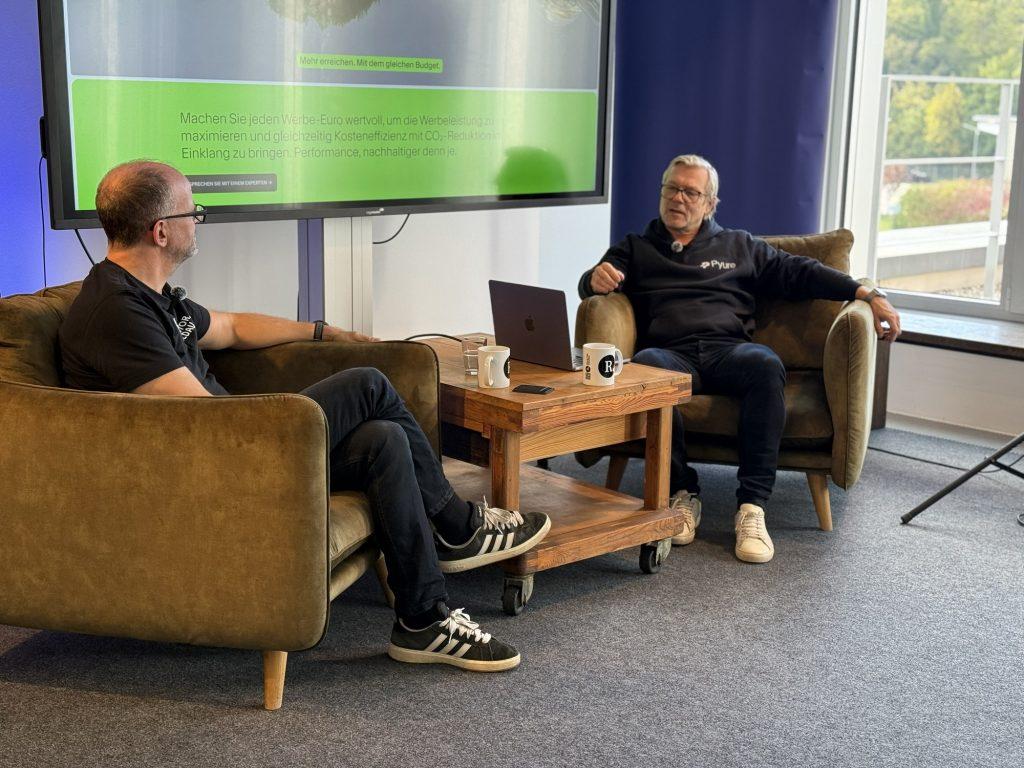
Rafael Kugel: But these two are actually closely linked. If I use less energy, I save costs at the same time. Using resources efficiently makes sense both ecologically and economically.
François Roloff: Exactly. In my opinion, the two always go hand in hand. But existing systems often find it incredibly difficult to change and break out of their usual routines.
For a long time, sustainability was viewed primarily as a cost issue. It’s only in recent years that we’ve begun to recognize more clearly that it can also yield economic benefits.
In the case of electric mobility, for example, this connection is relatively easy to explain. But how do you translate that into the advertising industry? How do you show a company that sustainability and economic efficiency go hand in hand when it comes to its marketing budget?
That’s exactly why we developed our technology.
“I’ve had this entrepreneurial spirit in me for a very long time”
Rafael Kugel: What drives you personally? Do you want to make the world a little better, or what is your motivation?
François Roloff: To a certain extent, I’m definitely a do-gooder.
By the way, I like the word “smart aleck.” I don’t think it’s all that negative. I even call my kids that sometimes, because I believe smart alecks have an important role to play. They’re the ones who spark ideas, think things through, and question the status quo.
I actually wanted to start my first business when I was 16. Back then, I had the idea for a wedding planning agency called “Marry Me.” I designed the flyers myself on my computer, printed them out, and distributed them in mailboxes.
After about a month, I actually got my first inquiries. Not from people who wanted to get married, though, but from insurance brokers who wanted to hire me as a salesperson.
Of course, that wasn’t quite what I’d imagined. But that entrepreneurial spirit has been a part of me for a very long time.
It just took me a while to combine that with my self-confidence and my experience. And I’ve gained that experience primarily in digital marketing and digital advertising, where I’ve been working for over 20 years now.
Rafael Kugel: Were you also the driving force behind PYURE? How did you all come together as a founding team?
François Roloff: Initially, I was definitely the driving force.
I had already been exploring the idea before I sold my last stake in a company in 2023 and stepped down from the management of my previous company.
Back then, I started thinking about how media budgets could even be analyzed from a sustainability perspective. There were hardly any established methods or concrete requirements for this. At the same time, the European Green Deal had already set the goal of making Europe climate-neutral by 2050.
So I did some research, found some initial methodological approaches, and spoke with many partners and former colleagues. Of course, there was some pushback along the way. But some people realized pretty quickly that there was a real gap here.
Then I approached Benjamin Rabinovic, who is now our Chief Product Officer.
We met repeatedly in Berlin-Mitte. Benjamin picked apart my ideas and stamped “no” on anything he thought wasn’t feasible.
But I kept coming back.
After I’d been working on him for almost a year, he finally agreed, and the two of us set out on our own.
I’ve known our co-founder Corinna for about 15 years. She brings a wealth of technology and industry expertise to the table. Once we had our first customers and initial proof that our concept worked, we finally came together as a founding team.
We officially founded the company in the first quarter of 2024. But we’d been working on the idea for much longer than that.
Rafael Kugel: When you look back on that time, what were the highlights and what were the low points?
François Roloff: That really tugs at my heartstrings.
Actually, starting a business is full of small moments of success. You just have to recognize them as such. Often, you notice the little hurdles you encounter every day much more than the things that are already working well.
To be honest, I can’t recall any absolute low points.
Of course, it’s disappointing when you run tests with customers and they then decide not to move forward. Sometimes that happens for reasons completely beyond our control.
Then you don’t get a second chance to do better. That really gets to us.
An absolute highlight, on the other hand, was our most recent internal demonstration of our own platform. We’d been working on it for so long, and suddenly what we’d always envisioned was actually clickable and working.
That was an incredibly wonderful moment.
A platform that turns data into concrete recommendations
Rafael Kugel: So explain how your platform works. What exactly can I do with it as a business?
François Roloff: Let’s say you’ve had a media plan created for Reaktor Wildau. It specifies where you want to run ads, during which time periods, and with what budget.
You simply upload this plan to our platform. It can be a CSV file or a PDF.
Within a maximum of 24 hours, we analyze the entire content, the emission potential, and other possible inefficiencies.
Above all, we’ll show you where you can optimize, what impact that could have, and which platforms you can use to implement these improvements.
We do this in such detail that it results in direct recommendations for action.
Rafael Kugel: And what do I do with these recommendations afterward?
François Roloff: Either you pass them on to your marketing manager or your marketing team, who will implement the optimizations manually. Or you can submit them directly to the platforms where you buy your ads and have the changes made automatically.
That’s exactly what we’re working on.
For me, it was truly a special moment when we saw these different features brought together for the first time on our own platform. You’ve had the product in your head for years, developing individual building blocks, and then at some point it’s actually there.
Rafael Kugel: How have your customers reacted to the new platform?
François Roloff: Many aren’t even familiar with it in this form yet.
When we first entered the market, we also worked with third-party technologies. As a startup, you can’t wait three years for your own technology to be fully ready before you even start working with customers.
That’s why we drove product development and market entry forward in parallel.
Now we’re in the process of migrating our customers to the new integrated tool. The initial reactions have been very positive.
Rafael Kugel: You also deal with sustainability reports. How exactly does that work?
François Roloff: That’s an important topic for us.
Until now, the carbon footprint of marketing activities has often been estimated rather roughly. For example, you take the advertising budget spent and multiply it by a certain factor.
But that doesn’t accurately account for which channels and platforms the ads were actually served on or the technical processes behind them.
Instead, we want to measure the actual activities and deliver more precise results based on that.
However, it’s important to clearly distinguish between a forecast and a measurement. Just because we can calculate in advance what savings might be possible doesn’t mean you can claim that you’ve actually become more sustainable.
Only after you’ve run and measured the campaigns do you have the basis for providing corresponding evidence.
Based on this, we can then generate a report directly from our platform that documents the emissions from the advertising activities and can be incorporated into a company’s sustainability reporting.
The Next Steps: New Clients, AI, and International Expansion
Rafael Kugel: Where is this journey headed? What are your next milestones? We’d like to meet again in two or three months and see what’s happened.
François Roloff: “Milestones” is exactly the right word.
We’ve roughly mapped out our development through 2030 and know where we want to be by then.
On the business side, the main focus for the next two to three months is on acquiring new potential customers and converting them into paying customers. We’re currently focusing particularly on media companies, insurance firms, and banks.
On the product side, we want to further integrate and expand our technology.
A very important step is making our technology available via MCP—that is, interfaces for AI agents.
This means that advertising platforms or buyers who work with AI agents can automatically transfer their data to us. We analyze it and send back the results and optimization recommendations.
In addition, we’ve just acquired a small Berlin-based startup, thereby expanding our offerings to include content marketing and social media.
Until now, we’ve mainly focused on paid media—that is, paid advertising. Now we can also incorporate organic social media marketing.
Looking ahead, we plan to add traditional advertising channels such as outdoor advertising and print. Our long-term goal is to cover the entire marketing spectrum.
Rafael Kugel: Do you already have partners for print and outdoor advertising?
François Roloff: We already have the methodological foundations in place and are having productive discussions with various marketing agencies and publishing houses.
The challenge isn’t so much that companies don’t want to talk to us. The bottleneck lies more in transferring data from traditional advertising processes into a digital analytics and reporting context.
What data comes from where? How can we link it all together and then use it for analysis and optimization? That’s what we need to figure out.
Rafael Kugel: So, to summarize, it’s about integrating your product lines, acquiring new customers, and further developing the technology. Is there a third major goal?
François Roloff: Yes, our emerging international expansion.
We’ve set out to target international and multinational clients more aggressively starting in 2027. Until now, we’ve been very focused on the DACH market.
However, we’re noticing that there are highly interesting companies and advertising markets in places like Poland and Slovenia that are focused on budget efficiency and sustainability.
Rafael Kugel: When you look at Europe, which markets are particularly open to green technologies? Where is it easier than in Germany?
François Roloff: I believe that, compared to the rest of Europe, France is likely the most advanced in our industry. There, requirements and initiatives for resource conservation were adopted and implemented relatively quickly.
The United Kingdom is also very advanced.
I’m specifically referring to the marketing and ad tech industry here, not sustainability in general.
In my estimation, it’s actually the hardest right now in Germany. Austria is also rather cautious. Switzerland is already a bit further along in terms of content and has been addressing these issues for longer.
That’s why our “more for your budget” pitch works so well right now. It’s a benefit that companies immediately understand, even in economically challenging times.
Rafael Kugel: Well, then we have plenty to come back to in our next conversation. I’m curious to see how your platform continues to develop, how many new customers you’ll gain, and how your expansion into international markets is going. Thank you very much for the insights, François.
François Roloff: My pleasure. Thank you very much for the interview. I enjoy being here at Reaktor and look forward to next time.
Rafael Kugel: After all, we’re only as good as the startups we work with. Thank you!





Newsletter
Startups, stories and stats from the German startup ecosystem straight to your inbox. Subscribe with 2 clicks. Noice.
LinkedIn ConnectFYI: English edition available
Hello my friend, have you been stranded on the German edition of Startbase? At least your browser tells us, that you do not speak German - so maybe you would like to switch to the English edition instead?
FYI: Deutsche Edition verfügbar
Hallo mein Freund, du befindest dich auf der Englischen Edition der Startbase und laut deinem Browser sprichst du eigentlich auch Deutsch. Magst du die Sprache wechseln?