Manufacturing Sector Has a Record Order Backlog, but Auto Exports and Rising Costs Highlight Weaknesses

German industry is sending mixed signals in late summer 2026. While the order backlog in the manufacturing sector rose to a new all-time high in July, German passenger car exports are declining. At the same time, producer prices are rising significantly again. Energy, metals, and transportation services, in particular, are becoming more expensive. The latest figures from the Federal Statistical Office thus paint a picture of an economy with substantial order backlogs, but one in which companies are simultaneously facing rising costs and shifts in international competition.
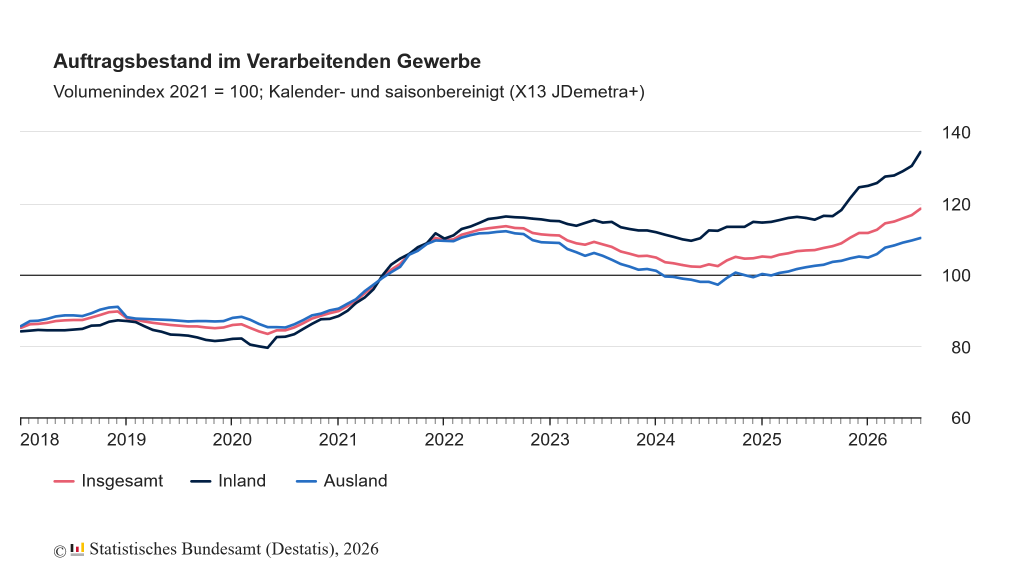
At first glance, the industrial outlook appears positive: The real order backlog in the manufacturing sector rose by 1.5 percent in July compared with the previous month, after seasonal and calendar adjustments. Compared to July 2025, the increase is as high as 10.9 percent. However, behind this record figure lies a strong concentration in specific sectors.
Order backlog reaches new all-time high
The order backlog in the manufacturing sector once again reached its highest level on record in July. The order coverage period is particularly noteworthy. If no new orders were to be received and companies were to maintain their sales at a constant level, the existing orders would, mathematically speaking, be sufficient for 9.0 months.
This marks the first time the nine-month mark has been reached since the time series began in 2015. In June, the lead time had stood at 8.9 months.
For capital goods manufacturers, order books are even filled for 12.6 months. For intermediate goods, the range is 4.6 months, and for consumer goods, 4.3 months.
The origin of the orders also shows a broad improvement at first glance. Outstanding orders from Germany rose by 3.0 percent compared to June, while those from abroad increased by 0.6 percent.
Aircraft, ships, trains, and military vehicles are driving the record
However, this record figure should not be confused with a widespread boom in German industry.
The key driver of this trend is the so-called “other vehicle manufacturing” sector. This includes, among other things, airplanes, ships, trains, and military vehicles. Here, the order backlog increased by a further 3.9 percent compared to June alone.
In these sectors, high order intake has recently coincided with comparatively long production times. Orders remain in the order books for a correspondingly long time, thereby increasing the statistical backlog. According to Destatis, without “Other Vehicle Manufacturing,” the industrial order backlog would be significantly below its previous high.
Mechanical engineering also made a positive contribution, with an increase of 0.8 percent. The situation is different, however, in one of Germany’s most important industrial sectors: in the automotive industry, the order backlog fell by 1.7 percent.
It is precisely this contrast that makes the current situation noteworthy. While some long-term-oriented capital goods sectors have built up enormous order buffers, the automotive industry is performing significantly weaker.
German passenger car exports fall by 4 percent
This trend is also reflected in foreign trade in vehicles. From January through July 2026, Germany exported approximately 2.0 million new passenger cars worth 73.5 billion euros. Compared to the same period last year, the number of vehicles exported fell by 4.0 percent.
The decline was even more pronounced in terms of value, with passenger car exports falling by as much as 8.9 percent.
The most important export markets were the United Kingdom with approximately 258,000 vehicles, the United States with 245,000, and Italy with 147,000 vehicles. Together, these three countries accounted for just under one-third of Germany’s new car exports. Even electric cars were not immune to the decline. Approximately 560,000 pure-electric cars were exported in the first seven months, 2.9 percent fewer than a year earlier. They accounted for 28.1 percent of all new cars exported.
Exports of hybrid vehicles fell by 8.2 percent to 380,000 vehicles. Internal combustion engine vehicles remain the largest group, with around one million vehicles and a share of 52.7 percent, though they also recorded a decline of 2.9 percent.
Particularly Sharp Drop in Electric Car Exports to the U.S.
Trade with the United States is showing a striking trend. A total of 245,000 new passenger cars, valued at 9.6 billion euros, were shipped to the U.S. In terms of volume, this represents a 2.6 percent decline. The export value, however, fell by 17.1 percent.
The differences between the various powertrain types are even more pronounced. While exports of internal combustion engine vehicles to the U.S. increased by 31.7 percent, exports of hybrid vehicles plummeted by 50.3 percent. For fully electric cars, the decline was 56.1 percent. Only about 25,000 German electric cars were exported to the United States between January and July.
This means that more than 80 percent of German passenger car exports to the U.S. consisted of internal combustion engine vehicles.
China Becomes Germany’s Largest Passenger Car Supplier
While Germany is exporting fewer vehicles, the number of imported new cars is rising significantly.
Approximately 1.3 million new passenger cars, valued at 34.9 billion euros, were imported into Germany between January and July. In terms of volume, this was 16.0 percent more than in the same period last year. Electric cars are experiencing particularly strong growth. Imports of pure electric vehicles rose by 66.3 percent to 309,000 vehicles. For hybrid vehicles, the increase was 36.0 percent to 403,000 vehicles.
The biggest change is evident in the countries of origin: For the first time, China is the leading supplier of new passenger cars!
Approximately 175,000 new cars—or 13.8 percent of all imports—came from China. Compared to the same period last year, this represents an increase of 120.9 percent. A year earlier, China had still been in fourth place. It is followed by the Czech Republic with 173,000 and Spain with 157,000 vehicles.
The figures thus reveal a shift in the German auto market. While exports by German manufacturers are declining, imports are rising—and Chinese vehicles, in particular, are gaining significantly in importance.
Producer prices rise by 4.6 percent
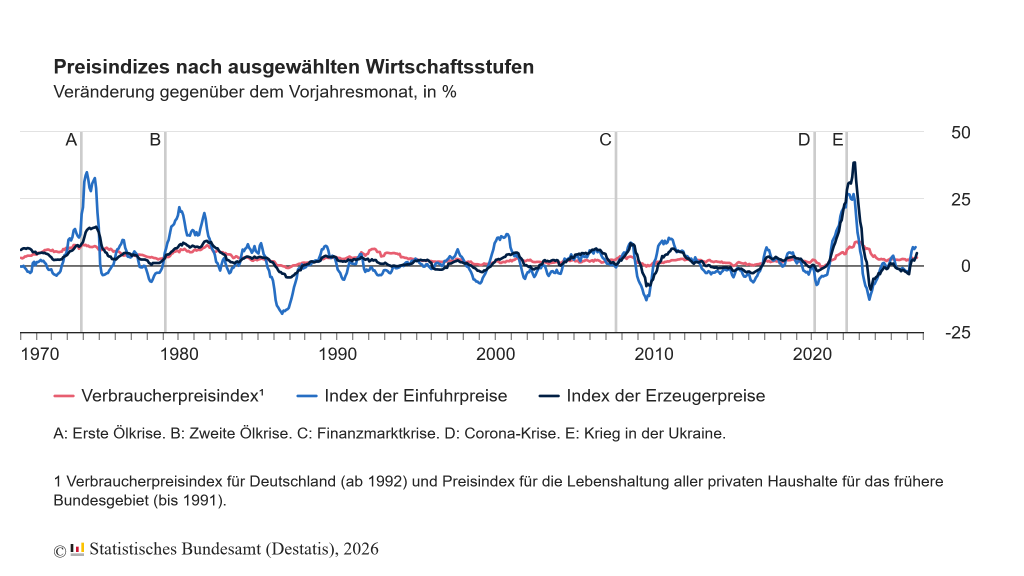
At the same time, cost pressures on companies are mounting again.
Producer prices for industrial products were 4.6 percent higher in August than a year earlier. Compared to July, they rose by 1.1 percent.
The main driver was energy prices, which rose by 8.3 percent compared to August 2025. Excluding energy, the annual increase in producer prices was 3.1 percent.
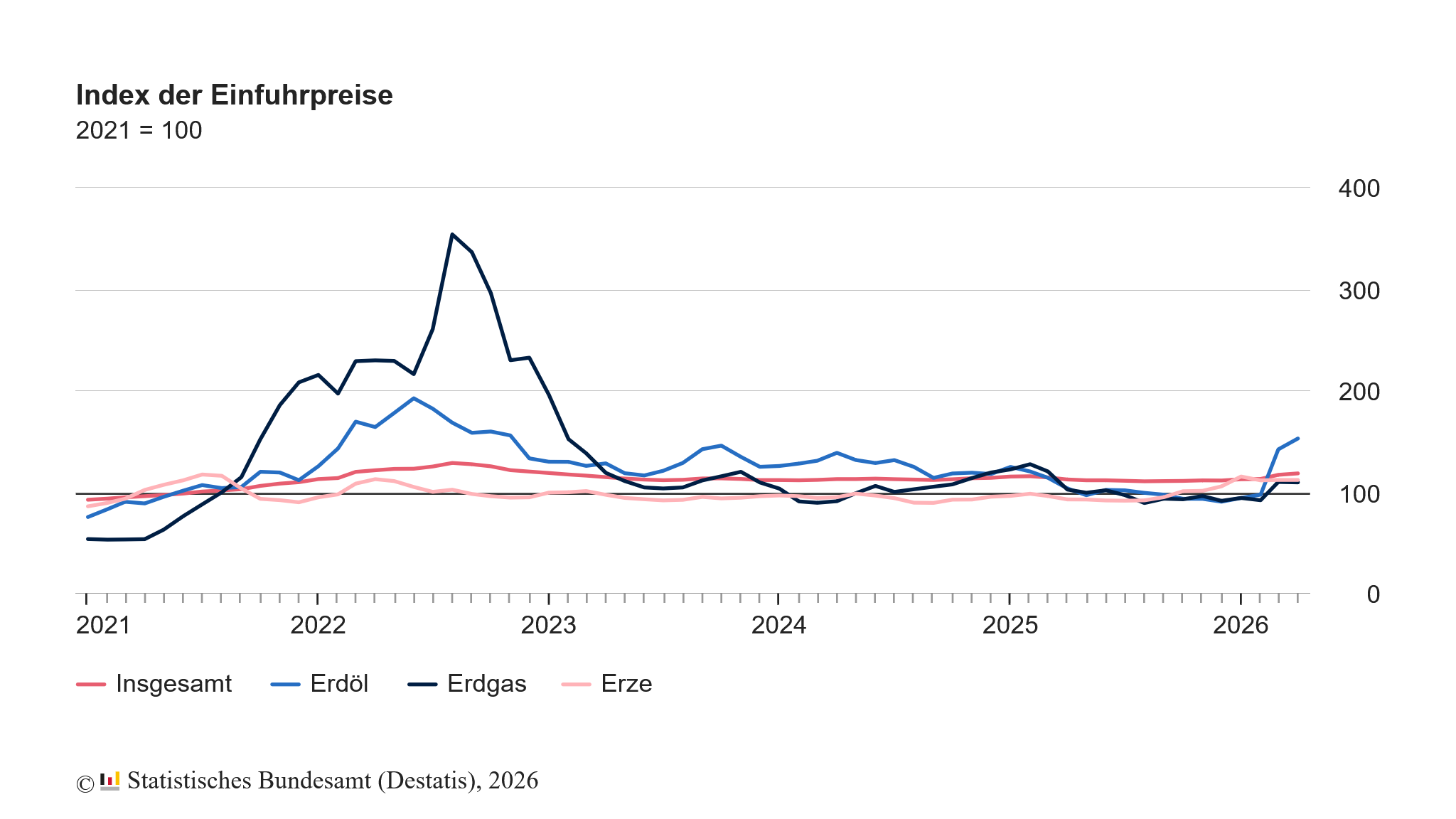
Prices for petroleum products rose particularly sharply. Destatis attributes this to the hostilities in Iran and the Middle East. Compared to August 2025, their prices were 40.5 percent higher. Light heating oil prices rose by 65.3 percent, and fuel prices by 37.7 percent.
Natural gas in the distribution network was also 7.5 percent more expensive, and electricity cost 1.7 percent more.
Metals and basic chemicals are becoming significantly more expensive
Cost pressures are not limited to energy. Intermediate goods rose in price by a total of 6.1 percent compared with the previous year.
Metals cost 14.8 percent more. Prices for precious metals, as well as copper and related semi-finished products, rose particularly sharply, each by 34.6 percent.
Basic chemical materials rose in price by 11.2 percent, while wood and wood and cork products increased by 7.1 percent.
Consequently, prices are rising for many of the very materials that are essential for industrial production and investment.
The trend was more moderate for capital goods, which rose in price by 2.4 percent. Machinery, as well as motor vehicles and motor vehicle parts, each cost 2.0 percent more than a year earlier.
Consumer goods showed the opposite trend, with producer prices falling by 2.0 percent. Food prices at the producer level were 4.3 percent lower overall.
Transportation and logistics are also facing cost pressures
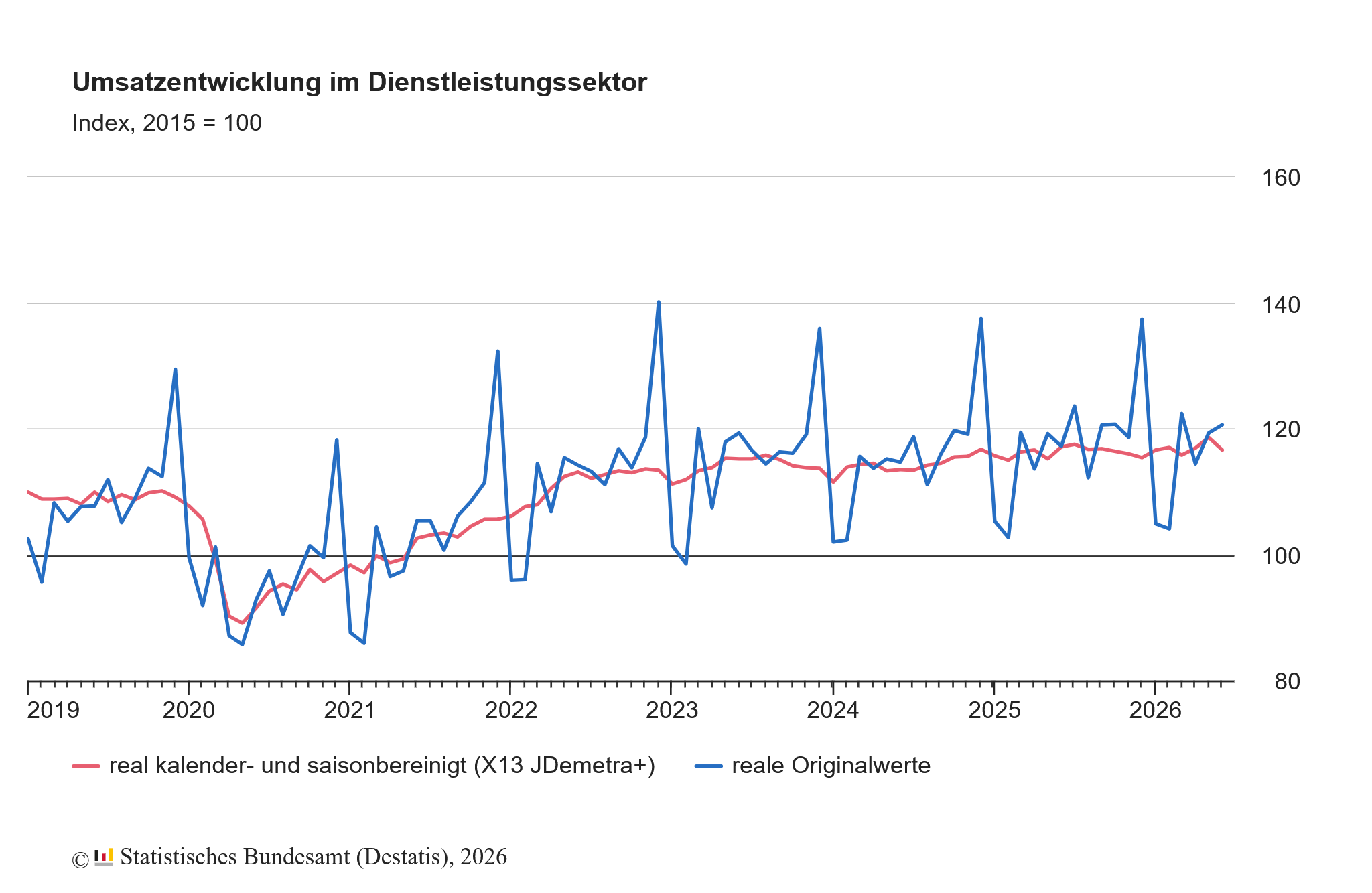
Rising costs are also making themselves felt in the services sector. Producer prices for services in the second quarter of 2026 were 3.7 percent higher than in the same quarter of the previous year and 1.6 percent higher than in the first quarter.
The sharpest increase was in transportation and warehousing, at 6.2 percent.
Prices in maritime and coastal shipping rose particularly sharply. The cost of maritime freight transport increased by 20.7 percent compared with the same quarter of the previous year and by as much as 23.4 percent compared with the first quarter.
Destatis cites rising fuel costs due to the war in Iran and the blockade of the Strait of Hormuz, as well as additional surcharges imposed by shipping companies, as the causes. Freight forwarding services rose by 6.2 percent compared to the previous year, while road freight transport increased by 5.8 percent. As a result, the rise in energy prices is affecting companies in several ways: directly through their own energy and fuel costs, and indirectly through more expensive transportation and logistics services.
Business services are also becoming more expensive
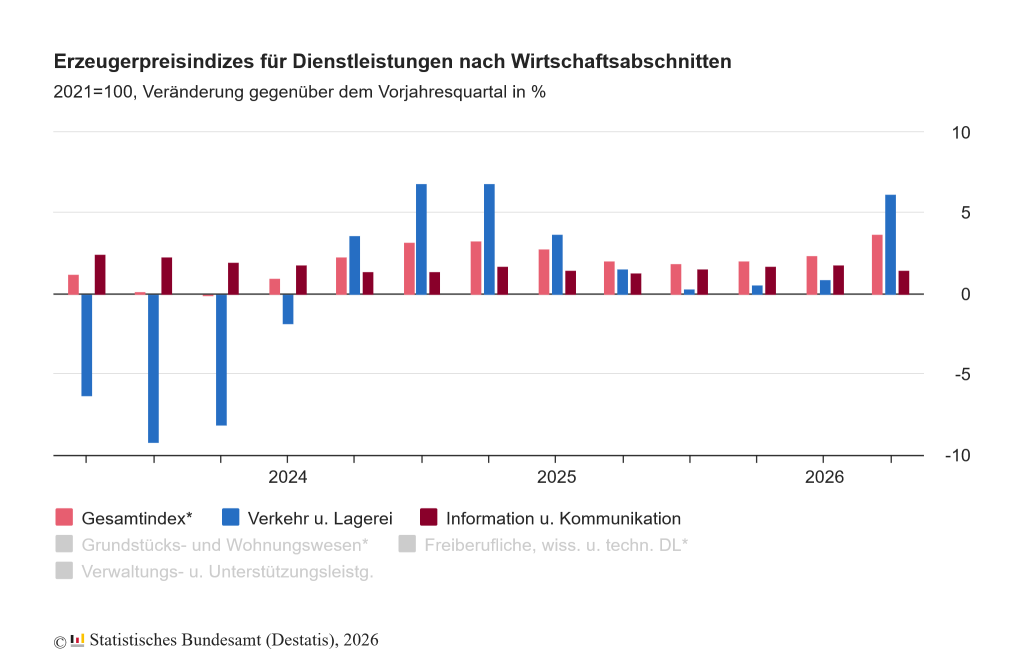
Beyond energy and logistics, prices are also rising, albeit at a more moderate pace.
In the information and communication sector, prices rose by 1.5 percent. Software and software licenses became 1.1 percent more expensive, while data processing and hosting rose by 1.4 percent.
In the real estate and housing sector, prices rose by 2.5 percent. Real estate brokerage and management services even rose by 5.4 percent. For professional, scientific, and technical services, the increase was 2.8 percent. Prices rose particularly sharply for accounting services (6.0 percent) and legal consulting (4.1 percent).
Companies are thus facing higher prices not only for raw materials and energy, but also for various externally procured services.
Full order books do not yet signal a new industrial boom
Taken together, the latest Destatis data paint a much more nuanced picture than the new all-time high in the order backlog might initially suggest.
On the one hand, there are record order books and a historic nine-month lead time. On the other hand, a significant portion of this strength is concentrated in the “other vehicle manufacturing” sector. At the same time, the automotive industry’s order backlog is declining, passenger car exports are falling, and producer prices are rising.
Developments in the automotive sector should be a cause for concern. The fact that China has risen from fourth place to become the most important source country for imported new cars within a year—with imports from there growing by more than 120 percent—while German passenger car exports are falling, underscores the increasing shift in international competitive dynamics.
Added to this are new cost pressures from energy, raw materials, and logistics. In the coming months, therefore, the decisive factor is likely to be not so much the record level of the total order backlog as the question of how broadly industrial demand is actually supported and whether companies can translate their high order backlogs into production, sales, and value added despite rising costs.

Newsletter
Startups, stories and stats from the German startup ecosystem straight to your inbox. Subscribe with 2 clicks. Noice.
LinkedIn ConnectFYI: English edition available
Hello my friend, have you been stranded on the German edition of Startbase? At least your browser tells us, that you do not speak German - so maybe you would like to switch to the English edition instead?
FYI: Deutsche Edition verfügbar
Hallo mein Freund, du befindest dich auf der Englischen Edition der Startbase und laut deinem Browser sprichst du eigentlich auch Deutsch. Magst du die Sprache wechseln?